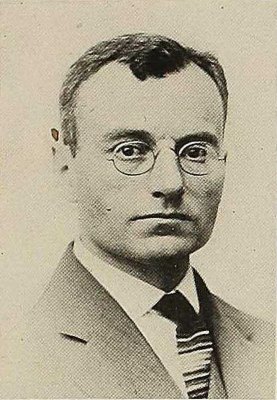
Carl Lotus Becker (September 7, 1873 – April 10, 1945) was an American historian who studied the American Revolution and the Age of Enlightenment in America and Europe.
Early life and education
He was born in Waterloo, Iowa. He enrolled at the University of Wisconsin in 1893 as an undergraduate, and while there, he gradually gained an interest in studying history. Remaining for graduate work, Becker studied under Frederick Jackson Turner, who became his doctoral adviser there. Becker received a Doctor of Philosophy degree in 1907.
Career
Becker taught at Pennsylvania State College, Dartmouth College, and the University of Minnesota. He was Professor of History at the University of Kansas from 1902 to 1916. He then became John Wendell Anderson Professor of History in the Department of History at Cornell University from 1917 to 1941.
He was elected a fellow of the American Academy of Arts and Sciences in 1923 and a member of the American Philosophical Society in 1936.
Writing
Becker's 1915 The Beginnings of the American People is often cited for a description of "colonial merchants" as "sunshine patriots". The "sunshine patriot" only appeared once in this book, and that in a quotation from Thomas Paine's first American Crisis essay, which concluded a series of parallelisms that, in turn, presaged the introduction of General George Washington to the narrative.
In this particular passage, Becker attempted to illustrate the "profound disillusionment" of the early years of the Revolutionary War, demonstrated by how "drudgery in obscure committee rooms was valued above declamation...the practical sense of [[