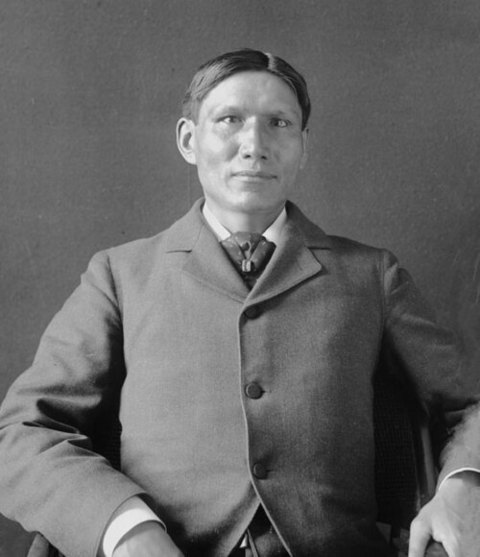
Charles Alexander Eastman (born Hakadah, later named Ohíyesa, February 19, 1858 – January 8, 1939) was an American physician, writer, and social reformer. He was "one of the most prolific authors and speakers on Sioux ethnohistory and American Indian affairs" in the early 20th century.
Eastman was of Santee Dakota, English and French ancestry. After working as a physician on reservations in South Dakota, he became increasingly active in politics and issues on Native American rights. He worked to improve the lives of youths: he founded thirty-two Native American chapters of the YMCA and helped to found the Boy Scouts of America. He was an early Native American historian.
Early life and education
Eastman was named Hakadah at his birth in Minnesota; his name meant "pitiful last" in Dakota. Eastman was so named because his mother died following his birth. He was the last of five children of Wakantakawin, a mixed-race woman also known as Winona (meaning "First-Born Daughter" in the Dakota language), or Mary Nancy Eastman. She and Eastman's father, a Santee Dakota named Wak-anhdi Ota (Many Lightnings), lived on a Santee Dakota reservation near Redwood Falls, Minnesota.
Winona was the only child of Wakháŋ Inážiŋ Wiŋ (Stands Sacred) and Seth Eastman, a U.S. Army career officer and illustrator, who married at Fort Snelling in 1830, where he was stationed. This post later developed as the city of Minneapolis. Stands Sacred was the fifteen-year-old daughter of Cloud Man, a Santee Dakota chief of French and Mdewakanton descent. Seth Eastman was reassigned from Fort Snelling in 1832, soon after the birth of Winona. The girl was later called Wakantakawin. Eastman left the two there, in Dakota country.