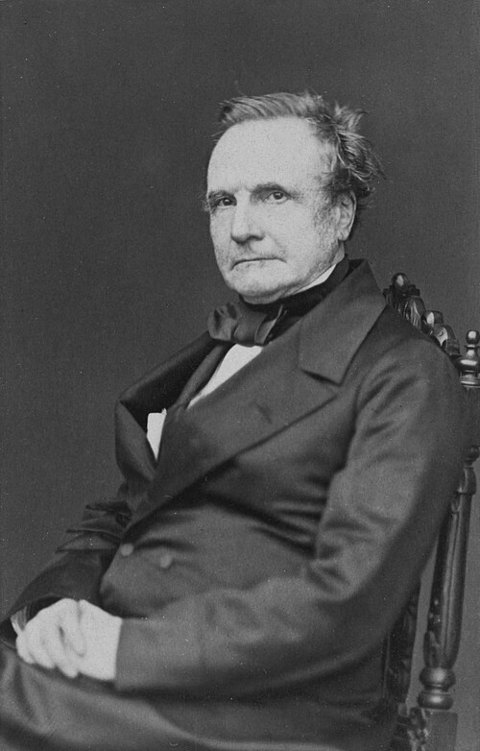
Charles Babbage (26 December 1791 – 18 October 1871) was an English polymath. A mathematician, philosopher, inventor and mechanical engineer, Babbage originated the concept of a digital programmable computer.
Babbage is considered by some to merit the title of "father of the computer". He is credited with inventing the first mechanical computer, the difference engine, that eventually led to more complex electronic designs, though all the essential ideas of modern computers are to be found in his analytical engine, programmed using a principle openly borrowed from the Jacquard loom. As part of his computer work, he also designed the first computer printers. He had a broad range of interests in addition to his work on computers, covered in his 1832 book Economy of Manufactures and Machinery. He was an important figure in the social scene in London, and is credited with importing the "scientific soirée" from France with his well-attended Saturday evening soirées. His varied work in other fields has led him to be described as "pre-eminent" among the many polymaths of his century.
Babbage, who died before the complete successful engineering of many of his designs, including his Difference Engine and Analytical Engine, remained a prominent figure in the ideating of computing. Parts of his incomplete mechanisms are on display in the Science Museum in London. In 1991, a functioning difference engine was constructed from the original plans. Built to tolerances achievable in the 19th century, the success of the finished engine indicated that Babbage's machine would have worked.