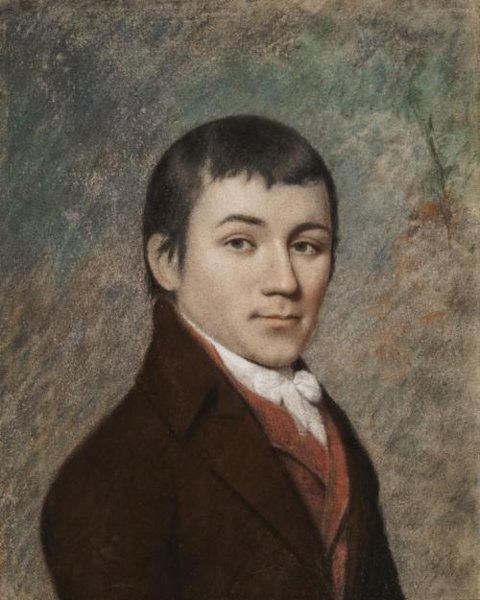
Charles Brockden Brown (January 17, 1771 – February 22, 1810) was an American novelist, historian, and editor of the Early National period.
Brown is regarded by some scholars as the most important American novelist before James Fenimore Cooper. Although Brown was not the first American novelist, as some early criticism claimed, the breadth and complexity of his achievement as a writer in multiple genres (novels, short stories, essays and periodical writings, poetry, historiography, and reviews) makes him a crucial figure in literature of the early republic. His best-known works include Wieland and Edgar Huntly, both of which display his characteristic interest in Gothic themes. He has been referred to as the "Father of the American Novel."
Early life
Brown was born on January 17, 1771, the fourth of five brothers and six surviving siblings in a Philadelphia Quaker merchant family. His father Elijah Brown, originally from Chester County, Pennsylvania, just southwest of Philadelphia, had a variable career primarily as a land-conveyancer or real estate agent. The two oldest brothers, Joseph and James, and youngest brother Elijah, Jr., were import-export merchants and bought shares in re-export ventures as early as the 1780s. Brown became a reluctant partner of their short-lived family firm, James Brown & Co., from late 1800 to the firm's dissolution in 1806. The third brother, Armitt, was a clerk in the early 1790s for the Treasury Department and at the Bank of Pennsylvania (for a time Armitt was a clerk with Alexander Hamilton), and later participated in the brothers' import-export firm. The family's mercantile background and experiences in the global trade and trade conflicts of the Revolutionary era are relevant to Brown's writings insofar as he often explored issues connected to the period's culture of commerce and the role that commerce plays in the historical transition from 18th-century civic republicanism to 19th-century laissez-faire liberalism and capitalism.