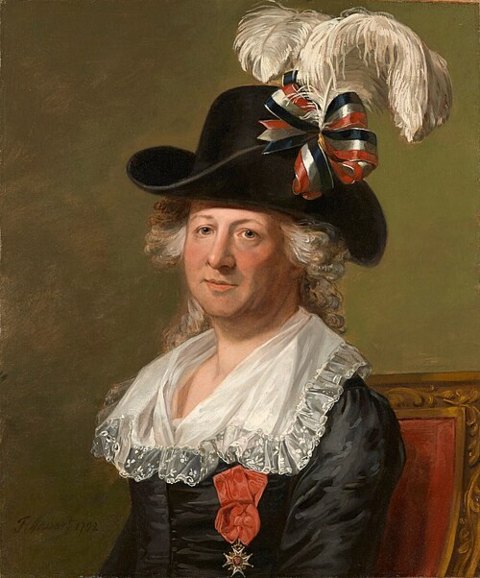
Charlotte d'Éon de Beaumont (5 October 1728 – 21 May 1810), usually known as the Chevalière d'Éon or the Chevalier d'Éon, was a French diplomat, spy, and soldier. D'Éon fought in the Seven Years' War, and spied for France while in Russia and England. Assigned male at birth, D'Éon had androgynous physical characteristics and natural abilities as a mimic and spy. She appeared publicly as a man and pursued masculine occupations for the first half of her life, except for when she successfully infiltrated the court of Empress Elizabeth of Russia by presenting as a woman. Starting in 1777, d'Éon lived as a woman and was officially recognised as such by King Louis XVI.
Early life, family, and education
D'Éon was born Charles d'Éon de Beaumont at the Hôtel d'Uzès in Tonnerre, Burgundy, into a poor French noble family. Her father, Louis d'Éon de Beaumont, was an attorney and director of the king's dominions, then later mayor of Tonnerre and sub-delegate of the intendant of the généralité of Paris. Her mother, Françoise de Charanton, was the daughter of a Commissioner General to the armies of the wars of Spain and Italy.
Most of what is known about d'Éon's early life comes from The Interests of the Chevalier d'Éon de Beaumont, a partly ghost-written autobiography, and from Bram Stoker's essay in his 1910 book Famous Impostors.
D'Éon excelled in school, moving from Tonnerre to Paris in 1743. She graduated in civil and canon law from the Collège Mazarin in 1749 at the age of 21.
Career
D'Éon began literary work as a contributor to Élie Catherine Fréron's Année littéraire, and attracted notice as a political writer through two works on financial and administrative questions, published in 1753. She became secretary to Bertier de Sauvigny, intendant of Paris, served as a secretary to the administrator of the fiscal department, and was appointed a royal censor for history and literature by Malesherbes in 1758.