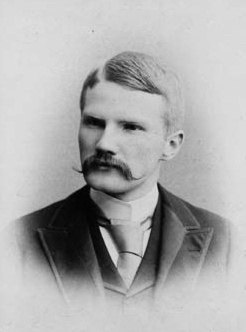
Charles Homer Haskins (December 21, 1870 – May 14, 1937) was an American medievalist at Harvard University. He was an advisor to U.S. President Woodrow Wilson. He is widely recognized as the first academic medieval historian in the United States, and the Haskins Medal was named in his honor.
Biography
Haskins was born in Meadville, Pennsylvania.
He was a prodigy, fluent in both Latin and Greek while still a young boy, taught by his father. He graduated from Johns Hopkins University at the age of 16, and then studied in Paris and Berlin. He received a Ph.D. in history from Johns Hopkins University and began teaching there before the age of 20. In 1890, he was appointed instructor at the University of Wisconsin, became a full professor in two years, and from 1892 to 1902 held the European history chair there. In 1902 he moved to Harvard University, where he taught until 1931.
Haskins became politically involved enough to become a close advisor of U.S. President Woodrow Wilson, whom he had met at Johns Hopkins. When Wilson attended the Paris Peace Conference of 1919 where the Treaty of Versailles was drawn up, he brought only three advisors including Haskins, who served as chief of the Western European division of the American commission.
Haskins was elected to the American Academy of Arts and Sciences in 1913 and the American Philosophical Society in 1921.
He died on May 14, 1937, in Cambridge, Massachusetts. His widow died in 1970.
Legacy
He was primarily a historian of institutions, like medieval universities and governments. His works reflect the mostly twentieth-century optimistic, liberal view that progressive government by "the best and brightest" is the way to go. His histories of medieval Europe's institutions stress the efficiency and successes of their governing bureaucracies, implicitly analogous to those of modern nation states.