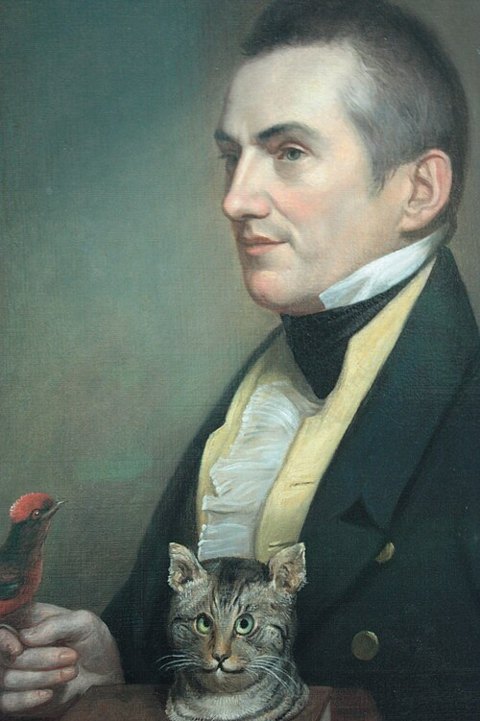
Charles Waterton (3 June 1782 – 27 May 1865) was an English naturalist, plantation overseer and explorer best known for his pioneering work regarding conservation.
Family and religion
Waterton was of a Roman Catholic landed gentry family descended from Reiner de Waterton and Thomas More. The Watertons had remained Catholic after the English Reformation and consequently the vast majority of their estates were confiscated. Charles Waterton himself was a devout and ascetic Catholic, and maintained strong links with the Vatican.
"Squire" Waterton was born at Walton Hall, Wakefield, Yorkshire, to Thomas Waterton and Anne Bedingfield.
He was educated at Stonyhurst College in Lancashire where his interest in exploration and wildlife were already evident. On one occasion Waterton was caught by the school's Jesuit Superior scaling the towers at the front of the building; almost at the top, the Superior ordered him to come down the way he had gone up. Waterton records in his autobiography that while he was at the school: By a mutual understanding, I was considered rat-catcher to the establishment, and also fox-taker, foumart-killer, and cross-bow charger at the time when the young rooks were fledged.... I followed up my calling with great success. The vermin disappeared by the dozen; the books were moderately well-thumbed; and according to my notion of things, all went on perfectly right.
South America
In 1804 he travelled to British Guiana to take charge of his uncle's slave plantations near Georgetown. In 1812 he started to explore the hinterland of the colony, making four journeys between then and 1824, and reaching Brazil walking barefoot in the rainy season. He described his discoveries in his book Waterton's Wanderings in South America, which inspired British schoolboys such as Charles Darwin and Alfred Russel Wallace. His explorations laid to rest the persistent myth of Raleigh's Lake Parime by suggesting that the seasonal flooding of the Rupununi savannah had been misidentified as a lake.