Three Years' War
Online reading View book
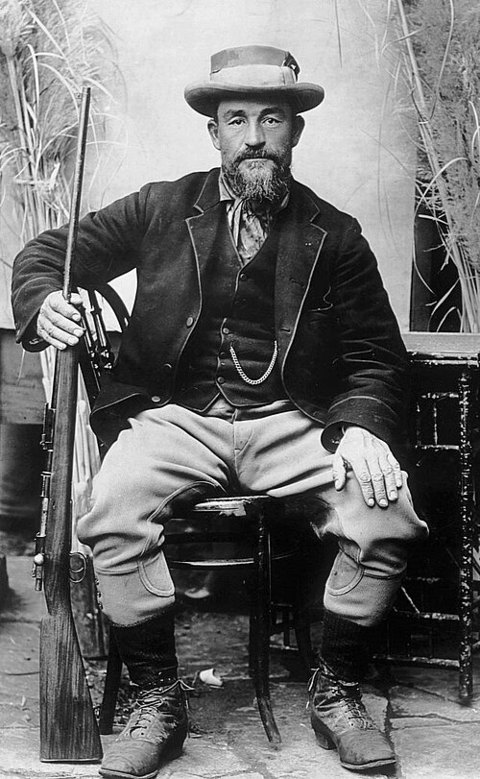
Author
Boer general, rebel and politician (1854-1922)
Christiaan Rudolf de Wet (7 October 1854 – 3 February 1922) was a Boer general, rebel leader and politician.
Born on the Leeuwkop farm, in the district of Smithfield in the Boer Republic of the Orange Free State, he later resided at Dewetsdorp, named after his father, Jacobus Ignatius de Wet. He married a woman named Cornelia Margaretha Krüger, and together they had 16 children. He also had a grandson that was born two years after his death named Carel de Wet.
De Wet served in the First Boer War of 1880–81 as a field cornet, taking part in the Battle of Majuba Hill, in which the Boers achieved a victory over a British force under the command of Major-General Sir George Pomeroy Colley. This eventually led to the end of the war and the reinstatement of the independence of the Zuid-Afrikaansche Republiek, more commonly known as the Transvaal Republic.
In the years between the First and Second Boer Wars, from 1881 to 1896, he lived on his farm, becoming a member of the Volksraad in 1897.
In September 1899, de Wet and his three sons were called up as ordinary private burghers without any rank. He was a member of the Heilbron kommando and they were ordered to proceed to the Natal frontier. On 11 October 1899, while he was reconnoitring the Natal frontier, De Wet was elected vice-commandant of Heilbron. He participated in the fight at Nicholson's Nek on 30 October, when a detachment of 954 British troops surrendered. Thereafter, he took part in the Siege of Ladysmith.
On 9 December 1899, De Wet received a telegram from the State President, M.T. Steyn, informing him that he had been appointed a fighting general and was to proceed to the Western frontier. He found General Piet Cronjé in command of the Boer forces ensconced at Magersfontein, south of Kimberley, while the British were at the Modder River. De Wet was to be Cronjé's second-in-command. The British advance commenced on 11 February 1900, with General French outflanking Cronjé at Magersfontein and riding towards Kimberley. De Wet's raid on the ox wagon convoy at Watervals Drift (Waterval Drift/Watervalsdrift), capturing 1600 oxen, did not stem the tide. The Siege of Kimberley was relieved on 15 February, and Cronjé surrendered with 4000 men at Paardeberg on 27 February. Shortly thereafter, de Wet was appointed Commander-in-Chief of the Free State forces. They could not contain the British advance towards the Free State capital, Bloemfontein, which was taken unopposed on 13 March 1900.
Text: “Christiaan de Wet”, from Wikipedia, the free encyclopedia, under the license CC BY-SA 4.0. Dates and facts: Wikidata.
Collection
1 book