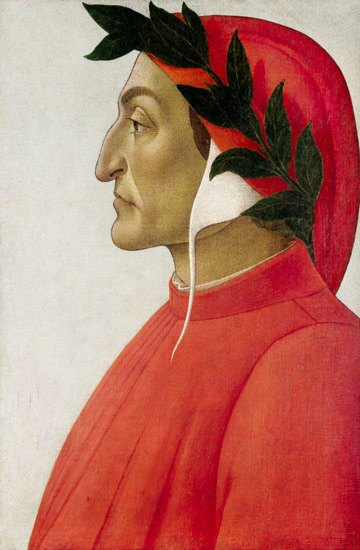
Dante Alighieri (Italian: [ˈdante aliˈɡjɛːri]; most likely baptized Durante di Alighiero degli Alighieri; c. May 1265 – September 14, 1321), widely known mononymously as Dante, was an Italian poet, writer, and philosopher. His Divine Comedy, originally called Comedìa (modern Italian: Commedia) and later christened Divina by Giovanni Boccaccio, is widely considered one of the most important poems of the Middle Ages and the greatest literary work in the Italian language.
At a time when Latin was still the dominant language for scholarly and literary writing—and when many Italian poets drew inspiration from French or Provençal traditions—Dante broke with both by writing in the vernacular, specifically his native Tuscan dialect. His De vulgari eloquentia (On Eloquence in the Vernacular) was one of the first scholarly defenses of the vernacular as well as a watershed study of the troubadour tradition and its craft of rhyme. His use of the Florentine dialect for works such as The New Life (1295) and Divine Comedy helped establish the modern-day standardized Italian language. His work set a precedent that important Italian writers such as Petrarch and Boccaccio would later follow.
Dante was instrumental in establishing the literature of Italy, and is considered to be among the country's national poets and the Western world's greatest literary icons. His depictions of Hell, Purgatory, and Heaven provided inspiration for the larger body of Western art and literature. He influenced English writers such as Geoffrey Chaucer, John Milton, and Alfred Tennyson, among many others. In addition, the first use of the interlocking three-line rhyme scheme, or the terza rima, is attributed to him. He is described as the "father" of the Italian language, and in Italy he is often referred to as il Sommo Poeta ("the Supreme Poet"). Dante, Petrarch, and Boccaccio are also called the tre corone ("three crowns") of Italian literature.