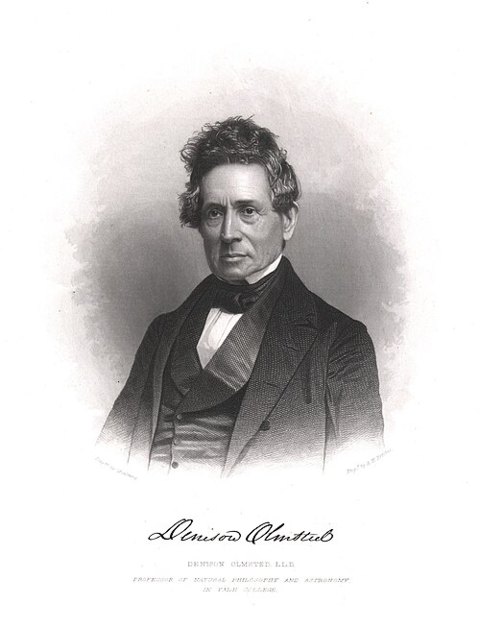
Denison Olmsted (June 18, 1791 – May 13, 1859) was an American physicist and astronomer. Olmsted is credited with giving birth to meteor science after the 1833 Leonid meteor shower over North America spurred him to study this phenomenon.
Biography
Olmsted was born June 18, 1791, in East Hartford, Connecticut. In 1813, he graduated from Yale College, where he acted as college tutor from 1815 to 1817. In the latter year, he was appointed to the chair of chemistry, mineralogy and geology in the University of North Carolina at Chapel Hill. A gold rush in North Carolina spurred the state legislature to sponsor the first state geological survey that was ever attempted in the United States. Olmsted traveled by horseback across the state collecting minerals and fossils, publishing his geological map in 1825.
In 1825, he became professor of mathematics and natural philosophy at Yale. He published an elaborate theory of hail-stones in 1830, which caused much discussion, but finally received the general approbation of meteorologists. The shower of shooting stars that fell in November 1833 attracted his attention, and he studied their history and behavior until he was able satisfactorily to demonstrate their cosmical origin. Olmsted appears to have been the earliest person to use the word radiator to mean a heating appliance in a patent of 1834 when he wrote that it was a peculiar kind of apparatus, which I call a radiator. Olmsted and his associate, Elias Loomis, were in 1835 the first American investigators to observe the Halley's Comet.