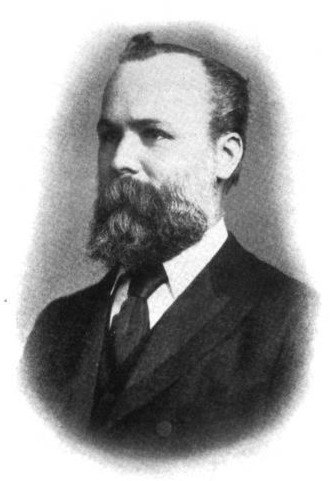
Edward Walter Maunder (12 April 1851 – 21 March 1928) was a British astronomer. His study of sunspots and the solar magnetic cycle led to his identification of the period from 1645 to 1715 that is now known as the Maunder Minimum.
Early and personal life
Maunder was born in 1851, in London, the youngest child of a minister of the Wesleyan Society. He attended King's College London but never graduated. He took a job in a London bank to finance his studies.
In 1873 Maunder returned to the Royal Observatory, taking a position as a spectroscopic assistant. Shortly after, in 1875, he married Edith Hannah Bustin, who gave birth to six children: four sons (one of whom died in infancy) and two daughters. Following the death of Edith in 1888, in 1890 he met Annie Scott Dill Russell (later Annie Russell Maunder), a mathematician and astronomer educated at Girton College in Cambridge, with whom he collaborated for the remainder of his life. She worked as a "lady computer" at the Observatory from 1890 to 1895.
In 1895 Maunder and Russell married. In 1916 Annie Maunder became one of the first women accepted by the Royal Astronomical Society.
Solar observations
Part of Maunder's job at the Observatory involved photographing and measuring sunspots, and in doing so he observed that the solar latitudes at which sunspots occur varies in a regular way over the course of the 11-year cycle. After 1891, he was assisted in his work by his wife Annie Maunder. In 1904, he published their results in the form of the butterfly diagram.
After studying the work of Gustav Spörer, who examined old records from the different observatories archives looking for changes of the heliographic latitude of sunspots, Maunder presented a paper on Spörer's conclusions to the Royal Astronomical Society in 1890 and analyzed the results to show the presence of a prolonged sunspot minimum in the 17-18th century in a paper published in 1894. The period, recognised initially by Spörer, now bears the name Maunder minimum.