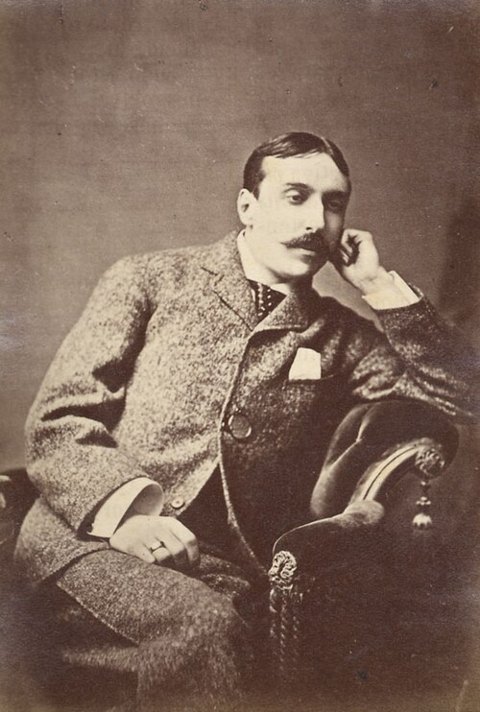
José Maria de Eça de Queiroz or Queirós (European Portuguese: [ˈɛsɐ ðɨ kɐjˈɾɔʃ]; 25 November 1845 – 16 August 1900) is generally considered to have been the greatest Portuguese writer in the realist style. Zola considered him to be far greater than Flaubert. In the London Observer, Jonathan Keates ranked him alongside Dickens, Balzac and Tolstoy.
Biography
Eça de Queiroz was born in Póvoa de Varzim, Portugal, on the 25th of November 1845, as the illegitimate child of José Maria de Almeida Teixeira de Queiroz and Carolina Augusta Pereira d'Eça, both unmarried.
Carolina's mother forbade their relationship, and it was only following her death that the couple were able to wed, when Eça was already four years old. To avoid a possible scandal, Carolina had had to leave the family home temporarily so that she could give birth away from prying eyes. The child, the first of seven siblings, would be christened as the son of an unknown mother and was recognized only after his parents married. Eça was raised chiefly by, and continued to live with, his grandparents up to the age of ten. Through his parents he was a relative of several authors like Alexandre O'Neill, Fernando Pessoa or Júlio Dantas, and the Portuguese footballer João Neves. He is also the great-great-grandfather of contemporary Portuguese author Afonso Reis Cabral.
At age 16, he began studying law at the University of Coimbra, where he met and befriended the Azorean poet Antero de Quental. Eça's first work consisted of a series of prose poems published in the Gazeta de Portugal, which eventually appeared in book form in a posthumous collection, edited by Batalha Reis, and entitled Prosas Bárbaras ("Barbarous texts"). He worked as a journalist at Évora, then returned to Lisbon and, together with his former school friend Ramalho Ortigão and others, conceived and created the Correspondence of the fictional adventurer Fradique Mendes. The work was first published in 1900.