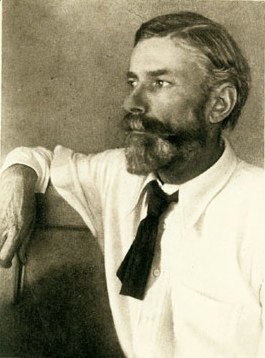
Edward Carpenter (29 August 1844 – 28 June 1929) was an English utopian socialist, poet, philosopher, anthologist, an early activist for gay rights and prison reform whilst advocating vegetarianism and taking a stance against vivisection. As a philosopher, he was particularly known for his publication of Civilisation: Its Cause and Cure. Here, he described civilisation as a form of disease through which human societies pass.
An early advocate of sexual liberation, he had an influence on both D. H. Lawrence and Sri Aurobindo, and inspired E. M. Forster's novel Maurice.
Early life
Born at 45 Brunswick Square, Hove in Sussex, Carpenter was educated at nearby Brighton College, where his father Charles Carpenter was a governor. His brothers Charles, George and Alfred also went to school there. Edward's grandfather was Admiral James Carpenter (1760–1845). When he was ten, Carpenter displayed a flair for the piano.
His academic ability became evident relatively late in his youth, but was sufficient to earn him a place at Trinity Hall, Cambridge. At Trinity Hall, Carpenter came under the influence of Christian Socialist theologian F. D. Maurice. Whilst there he also began to explore his feelings for men. One of the most notable examples of this is his close friendship with Edward Anthony Beck (later Master of Trinity Hall), which, according to Carpenter, had "a touch of romance". Beck eventually ended their friendship, causing Carpenter great emotional heartache. Carpenter graduated as 10th Wrangler in 1868. After university, he was ordained as curate of the Church of England, "as a convention rather than out of deep Conviction", and served as curate to Maurice at the parish of St Edward's, Cambridge.