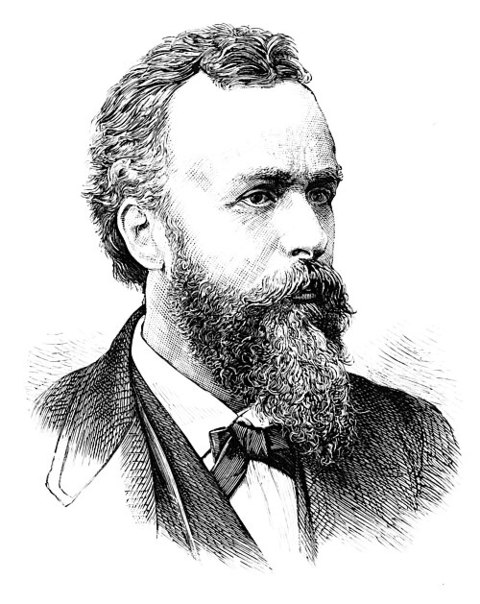
Edward Sylvester Morse (June 18, 1838 – December 20, 1925) was an American zoologist, archaeologist, and orientalist. He is considered the "Father of Japanese archaeology."
Early life
Morse was born in Portland, Maine to Jonathan Kimball Morse and Jane Seymour (Becket) Morse. His father was a Congregationalist deacon who held strict Calvinist beliefs. His mother, who did not share her husband's religious beliefs, encouraged her son's interest in the sciences. An unruly student, Morse was expelled from all but one of the schools he attended in his youth — the Portland village school, the academy at Conway, New Hampshire, in 1851, and Bridgton Academy in 1854 (for carving on desks). He also attended Gould Academy in Bethel, Maine. At Gould Academy, Morse came under the influence of Dr. Nathaniel True who encouraged Morse to pursue his interest in the study of nature.
He preferred to explore the Atlantic coast in search of shells and snails, or go to the field to study the fauna and flora. By the age of thirteen he had put together an impressive collection of shells. Despite his lack of formal education, his collections soon earned him the visit of eminent scientists from Boston, Washington and even the United Kingdom. He was noted for his work with land snails, and discovered two new species: Helix asteriscus, now known as Planogyra asteriscus, and H. Milium, now known as Striatura milium. These species were presented at meetings of the Boston Society of Natural History in 1857 and 1859.
He was a gifted draftsman, a skill that served him well throughout his career. As a young man, it enabled him to be employed as a mechanical draftsman at the Portland Locomotive Company and later preparing wood engravings for natural history publications. This relatively well-paid work enabled him to save enough money to support his further education. Morse was recommended by Philip Pearsall Carpenter to Louis Agassiz (1807–1873) at the Museum of Comparative Zoology at Harvard University for his intellectual qualities and talent at drawing. After completing his studies he served as Agassiz's assistant in charge of conservation, documentation and drawing collections of mollusks and brachiopods until 1862. He became especially interested in brachiopods during this time, and his first paper on the topic was published in 1862.