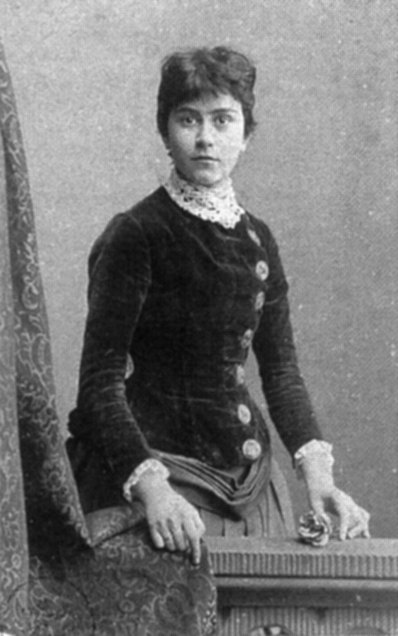
Else Lasker-Schüler (née Elisabeth Schüler) (German: [ˈɛl.zə ˈlas.kɐ ˈʃyː.lɐ]; 11 February 1869 – 22 January 1945) was a German poet and playwright. She was one of the few women affiliated with the Expressionist movement. Lasker-Schüler, who was Jewish, fled Nazi Germany and lived out the rest of her life in Jerusalem.
Biography
Schüler was born in Elberfeld, now a district of Wuppertal. Her mother, Jeannette Schüler (née Kissing) was a central figure in her poetry; the main character of her play Die Wupper was inspired by her father, Aaron Schüler, a Jewish banker from Wuppertal. Her brother Paul died when she was 13.
Else was considered a child prodigy because she could read and write at the age of four. From 1880 she attended the Lyceum West an der Aue. After dropping out of school, she received private lessons at her parents' home.
In 1894, Else married the physician and chess master Berthold Lasker (the elder brother of Emanuel Lasker, a World Chess Champion) and moved with him to Berlin, where she trained as an artist. On 27 July 1890 her mother died, her father followed 7 years later. On 24 August 1899, her son Paul was born and her first poems were published. She published her first full volume of poetry, Styx, three years later, in 1902. On 11 April 1903, she and Berthold Lasker divorced and on 30 November, she married Georg Lewin, artist, and founder of the Expressionist magazine Der Sturm. His pseudonym, Herwarth Walden, was her invention.
Lasker-Schüler's first prose work, Das Peter-Hille-Buch, was published in 1906, after the death of Hille, one of her closest friends. In 1907, she published the prose collection Die Nächte der Tino von Bagdad, followed by the play Die Wupper in 1909, which was not performed until later. A volume of poetry called Meine Wunder, published in 1911, established Lasker-Schüler as the leading female representative of German Expressionism.