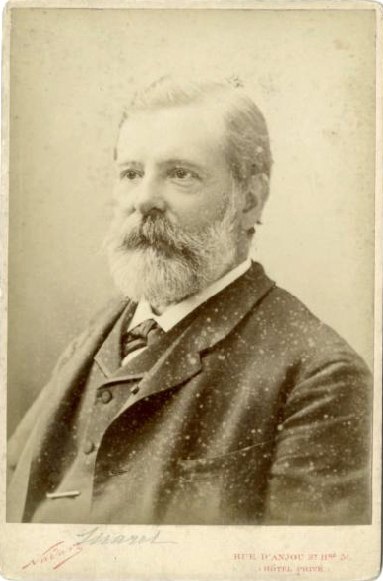
Étienne-Jules Marey (French: [etjɛn ʒyl maʁɛ]; 5 March 1830, Beaune, Côte-d'Or – 15 May 1904, Paris) was a French scientist, physiologist, and chronophotographer.
His work was significant in the development of cardiology, physical instrumentation, aviation, cinematography, and the science of laboratory photography. He is widely considered to be a pioneer of photography and an influential pioneer of the history of cinema. He was also a pioneer in establishing a variety of graphical techniques for the display and interpretation of quantitative data from physiological measurement.
Biography
Marey started by studying blood circulation in the human body. He then shifted to analyzing heart beats, respiration, muscles (myography), and movement of the body. To aid his studies, he developed many instruments for precise measurements. For example, in 1859, in collaboration with the physiologist Auguste Chauveau and the watch manufacturer Breguet, he developed a wearable Sphygmograph to measure the pulse. This sphygmograph was an improvement on an earlier and more cumbersome design by the German physiologist Karl von Vierordt. In 1869, Marey constructed a very delicate artificial insect to show how an insect flies and to demonstrate the figure-8 shape it produced during movement of its wings. He fixed a gold foil to an insect wing and shone light on it to study the flapping of the wing. He also used a soot covered glass-fibre introduced along the path of the insect wing to determine if it crossed with the wing in the upper stroke or lower stroke by examining the side on which the soot was cleared. Then, he became fascinated by movements of air and started to study bigger flying animals, like birds. He adopted and further developed animated photography into a separate field of chronophotography in the 1880s. His revolutionary idea was to record several phases of movement on one photographic surface. In 1890, he published a substantial volume entitled Le Vol des Oiseaux (The Flight of Birds), which was illustrated with photographs, drawings, and diagrams. He also created precise sculptures of various flying birds.