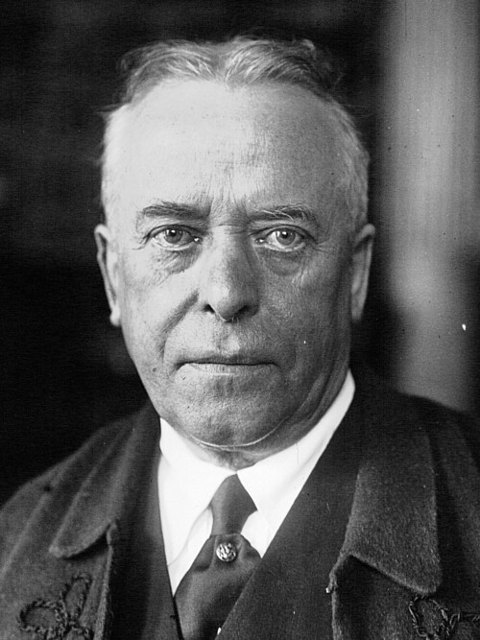
Eugène Brieux (French: [øʒɛn bʁijø]; 19 January 1858 – 6 December 1932) was a French dramatist.
Biography
Brieux grew up as the son of a carpenter in modest circumstances in the Temple District of Paris (3rd Arrondissement). His schooling was limited to attending the "École communale" and "École primaire supérieure" ("École Turgot"), which he completed at the age of 13. Nonetheless, he was very interested in literature, read a lot and wrote his first play at the age of 15. For many years, in which he unsuccessfully offered his manuscripts to various theaters, he earned his living as a bank clerk. For the first time one of his plays, Bernard Palissy, was performed in 1879, at the theater in Cluny, but only once.
On the basis of this limited success, Brieux first decided to try his hand at journalism. After a few years as a reporter in Dieppe, he became editor-in-chief of Le Nouvelliste in Rouen. In Rouen he also staged some less important plays without losing sight of a career in Paris. He found encouragement when his play Ménage des Artistes was performed at the Théâtre Libre in 1890. But it was only two years later that he finally made his breakthrough with the play Blanchette, which was performed over a hundred times by the theater manager and actor André Antoine and also toured the provinces.
On that basis Brieux returned to Paris, where he wrote articles for Patrie, Gaulois and Le Figaro. Between 1893 and 1899 he also worked as a theater and music critic for La Vie Contemporaine. Above all, however, he now wrote play after play. At first his works emphasized the comic, but his so-called 'Sturm und Drang [‘Storm and Stress’] period' began with the play Les Trois Filles de M. Dupont in 1897. In plays such as Le Berceau (1898), La Robe Rouge (1900), Les Avariés (1901) and Maternité (1903), he critically examined social problems such as poverty, political corruption, divorce, venereal diseases, the death penalty and parenthood. Later dramas like Les Hannetons (1906) or Simone (1908), on the other hand, were again more optimistic.