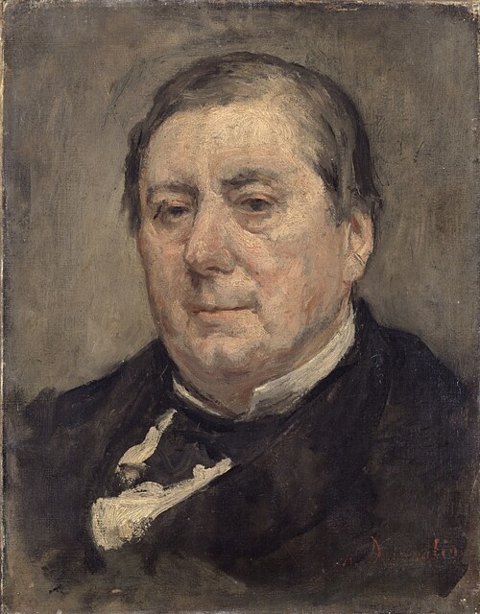
Eugène Marin Labiche (French pronunciation: [øʒɛn maʁɛ̃ labiʃ]; 6 May 1815 – 22 January 1888) was a French dramatist. He remains famous for his contribution to the farce genre (known in France as vaudeville) and his passionate and domestic pochades.
In the 1860s, he reached his peak with a series of successes including Le Voyage de M. Perrichon (1860), La Poudre aux yeux (1861), La Station Champbaudet (1862) and La Cagnotte (1864). He worked with Jacques Offenbach, then director of the Bouffes-Parisiens, to write librettos for operettas and for several comic operas.
His 1851 farce The Italian Straw Hat, written with Marc-Michel, has been adapted many times to stage and screen.
Early life
He was born into a bourgeois family and studied law. At the age of twenty, he contributed a short story to Chérubin magazine, entitled "Les plus belles sont les plus fausses" ("The most beautiful are the most fake/false"). A few others followed, but failed to catch the attention of the public.
Career
Labiche tried his hand at dramatic criticism in the Revue des théâtres and in 1838, wrote and premiered two plays.
The small Théâtre du Pantheon produced, to some popular success, his drama L'Avocat Loubet, while a vaudeville, Monsieur de Coyllin, ou l'homme infiniment poli (written in collaboration with Marc-Michel and performed at the Palais Royal) introduced a provincial actor who was to become and to remain a great Parisian favourite, the famous comedian Grassot.
In the same year, Labiche, still doubtful about his true vocation, published a romance called La Clé des champs. According to Léon Halévy, Labiche's publisher went bankrupt soon after the novel was out: "A lucky misadventure, for this timely warning of Destiny sent him back to the stage, where a career of success was awaiting him." There was yet another obstacle in the way. When he married, Labiche solemnly promised his wife's parents that he would renounce a profession then considered incompatible with moral regularity and domestic happiness. A year later, his wife released him from his vow, and Labiche recalled the incident when he dedicated the first edition of his complete works to her.