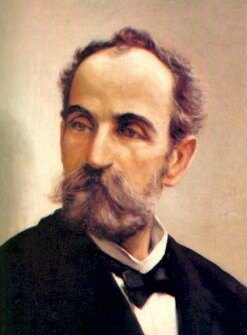
Eugenio María de Hostos y de Bonilla (January 11, 1839 – August 11, 1903), known as El Gran Ciudadano de las Américas ("The Great Citizen of the Americas"), was a Puerto Rican educator, philosopher, intellectual, lawyer, sociologist, novelist, and Puerto Rican independence advocate.
Early years and family
Eugenio María de Hostos y de Bonilla was born on January 11, 1839, to a well-to-do family in the Barrio Río Cañas of Mayagüez, Captaincy General of Puerto Rico (present-day Puerto Rico). His parents were Eugenio María de Hostos y Rodríguez (1807–1897) and María Hilaria de Bonilla y Cintrón (died 1862, Madrid, Spain), both of Spanish descent.
At a young age, his family sent him to study in the capital of the island, San Juan, where he received his elementary education in the Liceo de San Juan. In 1852, his family sent him to Bilbao, Spain, where he graduated from the Institute of Secondary Education (high school). After he graduated, he enrolled at the Complutense University of Madrid in 1857. He studied law, philosophy and letters. As a student there, he became interested in politics. In 1863, he published in Madrid what is considered his greatest work, La Peregrinación de Bayoán. When Spain adopted its new constitution in 1869 and refused to grant Puerto Rico its independence, Hostos left Spain for the United States.
Independence advocate
During his one-year stay in the United States, he joined the Cuban Revolutionary Committee and became the editor of a journal called La Revolución. Hostos believed in the creation of an Antillian Confederation (Confederación Antillana) between Puerto Rico, the Dominican Republic and Cuba. This idea was embraced by fellow Puerto Ricans Ramón Emeterio Betances and Segundo Ruiz Belvis. One of the things which disappointed Hostos was that in Puerto Rico and in Cuba there were many people who wanted their independence from Spain, but did not embrace the idea of becoming revolutionaries, preferring to be annexed by the United States.