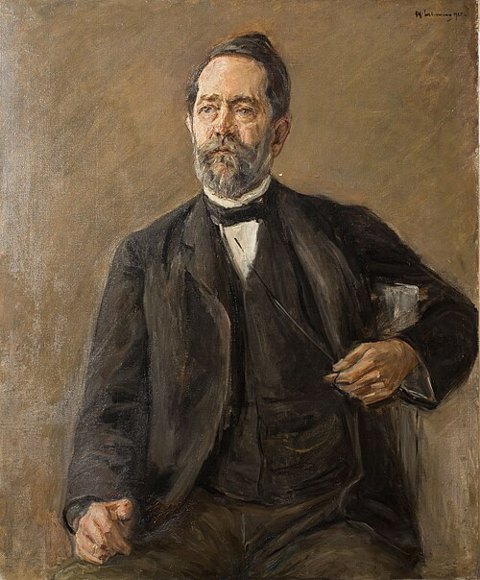
Felix Christian Klein (German: [klaɪn]; 25 April 1849 – 22 June 1925) was a German mathematician, mathematics educator and historian of mathematics, known for his work in group theory, complex analysis, non-Euclidean geometry, and the associations between geometry and group theory. His 1872 Erlangen program classified geometries by their basic symmetry groups and was an influential synthesis of much of the mathematics of the time.
During his tenure at the University of Göttingen, Klein was able to turn it into a center for mathematical and scientific research through the establishment of new lectures, professorships, and institutes. His seminars covered most areas of mathematics then known as well as their applications. Klein also devoted considerable time to mathematical instruction and promoted mathematics education reform at all grade levels in Germany and abroad. He became the first president of the International Commission on Mathematical Instruction in 1908 at the Fourth International Congress of Mathematicians in Rome.