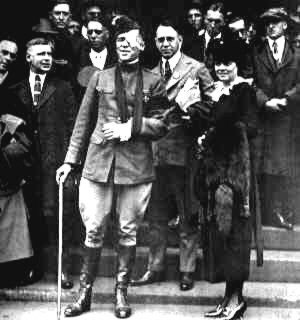
Floyd Phillips Gibbons (July 16, 1887 – September 23, 1939) was the war correspondent for the Chicago Tribune during World War I. One of radio's first news reporters and commentators, he was famous for a fast-talking delivery style. Floyd Gibbons lived a life of danger of which he often wrote and spoke.
Early life
Floyd Phillips Gibbons was born on July 16, 1887, in Washington, D.C. Gibbons moved with his family to Des Moines, Iowa and lived there from 1900 to 1903. He attended schools in Iowa and Minneapolis. His father owned a trading stamp business for merchants in Iowa. Gibbons attended Gonzaga College High School, and later studied law at Georgetown University, from which he was expelled.
Personal life
Gibbons was known by his contemporaries as "Gib". He married a woman from Minneapolis and they were later divorced.
Career
Gibbons began as a police reporter on the Minneapolis Daily News in 1907, but was fired. He also worked for the Milwaukee Free Press and the Minneapolis Tribune. While working for the Tribune in 1910, he was arrested for cutting a telegraph line in Winter, Wisconsin to prevent other newspapers from reporting a story first. He moved to the Chicago Tribune in 1912. He became well known for covering the Pancho Villa Expedition in 1916. He became a London correspondent for the Chicago Tribune in 1917 and reported on the 1917 torpedoing of the British ship RMS Laconia, on which he was a passenger.
The Chicago Tribune appreciated his keen eye for detail, and vivid splashy style. It sent him to England to cover World War I. As a correspondent at the Battle of Belleau Wood, France. Gibbons accompanied the Fifth Marines where his account of the battle that he submitted violated wartime censorship by mentioning that he was serving with the U.S. Marine Corps. Gibbons' colourful prose added to the reputation of the Marines. Gibbons lost an eye after being hit by German gunfire at Château-Thierry in June 1918 while attempting to rescue an American marine. Always afterwards he wore a distinctive white patch on his left eye. He was given France's greatest honor, the Croix de Guerre with palm, for his valor on the field of battle.