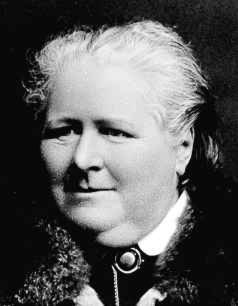
Frances Power Cobbe (4 December 1822 – 5 April 1904) was an Anglo-Irish writer, philosopher, religious thinker, social reformer, anti-vivisection activist and leading women's suffrage campaigner. She founded a number of animal advocacy groups, including the National Anti-Vivisection Society (NAVS) in 1875 and the British Union for the Abolition of Vivisection (BUAV) in 1898, and was a member of the executive council of the London National Society for Women's Suffrage.
Life
Frances Power Cobbe was a member of the prominent Cobbe family, descended from Archbishop Charles Cobbe, Primate of Ireland. She was born in Newbridge House in the family estate in present-day Donabate, County Dublin. Her niece Frances Conway Cobbe was one of the first 12 students at the newly founded women's college Somerville Hall (later Somerville College) in Oxford.
Cobbe was educated mainly at home by governesses with a brief period at a school in Brighton. She studied English literature, French, German, Italian, music, and the Bible. She then read heavily in the family library especially in religion and theology, joined several subscription libraries, and studied Greek and geometry with a local clergyman. She organised her own study schedule and ended up very well educated.
In the late 1830s, Cobbe went through a crisis of faith. The humane theology of Theodore Parker, an American transcendentalist and abolitionist, restored her faith (she went on later to edit Parker's collected writings). She began to set out her ideas in what became an Essay on True Religion. Her father disapproved and for a while expelled her from the home. She kept studying and writing anyway and eventually revised the Essay into her first book, the Essay on Intuitive Morals. The first volume came out anonymously in 1855.