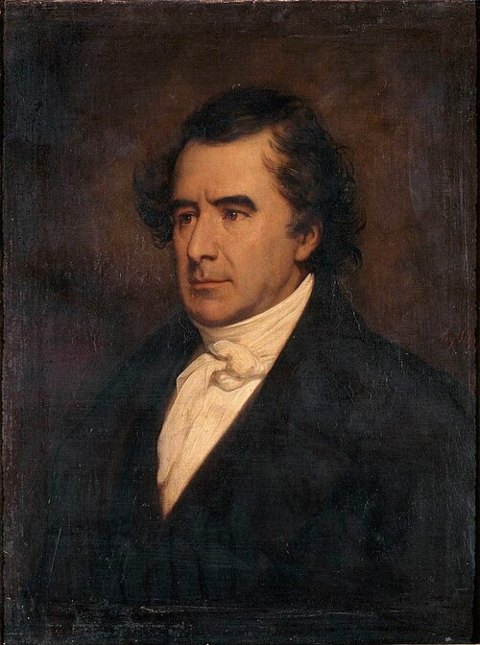
Dominique François Jean Arago (Catalan: Domènec Francesc Joan Aragó), known simply as François Arago (French: [fʁɑ̃swa aʁaɡo]; Catalan: Francesc Aragó, IPA: [fɾənˈsɛsk əɾəˈɣo]; 26 February 1786 – 2 October 1853), was a French mathematician, physicist, astronomer, freemason, supporter of the Carbonari revolutionaries, and politician.
In physics, he is known for helping establishing the wave theory of light. The Arago spot, an important experiment in optics that demonstrated this phenomenon, is named after him.
Early life and work
Arago was born at Estagel, a small village of 3,000 near Perpignan, in the département of Pyrénées-Orientales, France, where his father held the position of Treasurer of the Mint. His parents were François Bonaventure Arago (1754–1814) and Marie Arago (1755–1845).
Arago was the eldest of six brothers. Jean (1788–1836) emigrated to North America and became a general in the Mexican army. Jacques (1790–1854) took part in Louis de Freycinet's exploring voyage in the Uranie from 1817 to 1821, and on his return to France devoted himself to his journalism and the drama. Victor (1792–1867) was a French soldier. Joseph (1796–1860) became a soldier in the Mexican army. Étienne (1802–1892), is said to have collaborated with Honoré de Balzac in The Heiress of Birague, and from 1822 to 1847 wrote a great number of light dramatic pieces, mostly in collaboration.
Showing decided military tastes, François Arago was sent to the municipal college of Perpignan, where he began to study mathematics in preparation for the entrance examination of the École Polytechnique. Within two years and a half he had mastered all the subjects prescribed for examination, and a great deal more, and, on going up for examination at Toulouse, he astounded his examiner by his knowledge of J.-L. Lagrange's work.