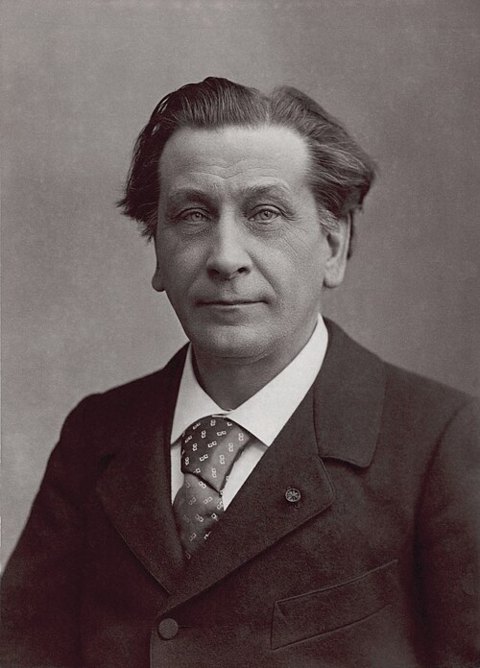
François Édouard Joachim Coppée (French pronunciation: [fʁɑ̃swa ədwaʁ ʒɔakim kɔpe]; 26 January 1842 – 23 May 1908) was a French poet and novelist.
Biography
Coppée was born in Paris to a civil servant. After attending the Lycée Saint-Louis he became a clerk in the ministry of war and won public favour as a poet of the Parnassian school. His first printed verses date from 1864. In 1869, his "Poèmes modernes" (among others La Grève de forgerons) were quite successful. In the same year, Coppée's first play, Le Passant, starring Sarah Bernhardt and Madame Agar, was received with approval at the Odéon theatre, and later Fais ce que dois (1871) and Les Bijoux de la délivrance (1872), short poetic dramas inspired by the Franco-Prussian War, were applauded.
After holding a post in the library of the senate, Coppée was chosen in 1878 as archivist of the Comédie Française, an office he held till 1884. In that year, his election to the Académie française caused him to retire from all public appointments. He was made an officer of the Legion of Honour in 1888.
Coppée was famed as le poète des humbles (the poet of the humble). His verse and prose focus on plain expressions of emotion, patriotism, the joy of young love, and the pitifulness of the poor. Coppée continued to write plays, mostly serious dramas in verse, two of which were composed in collaboration with Armand d'Artois. The performance of a short episode of the Commune, Le Pater, was prohibited by the government in 1889. Coppée published his first prose work in 1875 and went on to publish short stories, an autobiography of his youth, a series of short articles on miscellaneous subjects, and La Bonne Souffrance, a popular account of his reconversion to the Roman Catholic Church. His conversion was due to a severe illness which twice brought him close to death.