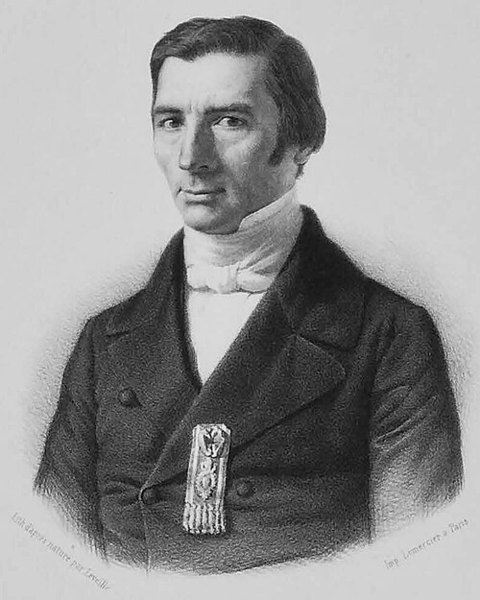
Claude-Frédéric Bastiat (French: [klod fʁedeʁik bastja]; 30 June 1801 – 24 December 1850) was a French economist, writer, and prominent member of the French liberal school.
A member of the French National Assembly, Bastiat developed the economic concept of opportunity cost and introduced the parable of the broken window. He was described as "the most brilliant economic journalist who ever lived" by economic theorist Joseph Schumpeter.
As an advocate of classical economics and the economics of Adam Smith, his views favored a free market and influenced the Austrian School. He is best known for his book The Law, where he argued that law must protect rights such as private property, not "plunder" others' property.
Biography
Bastiat was born on 29 June 1801 in Bayonne, Gascony (Aquitaine), a port town in the south of France on the Bay of Biscay. His grandfather Pierre Bastiat (1742–1825) had come to trade in Bayonne from the inland town of Mugron in the wine-growing region of Chalosse and the Landes department, married Bastiat's grandmother Catherine Laulhé (also from the Chalosse) in 1770. Having armed a frigate at his own expense for the War of the Pyrenees in 1793 to improve his standing with the Republic, Pierre Bastiat acquired the estate of Sengresse (just north of Mugron), confiscated during the French Revolution from the house of Béthune-Chârost, at an auction on 9 June 1795, in the closing stages of the war, and made it his family's residence. The bourgeois prosperity launched by Bayonne's new status as a free port from 1784 was cut short by the dissolution of the town's chamber of commerce in 1791, the ensuing wars with Spain (1793–1795, 1807–1814), and the Continental Blockade (1806–1814); the Bastiat family then shifted its interests to privateering and trading with the American colonies. Bastiat's father, Pierre (1771–1810), the eldest of seven children and also a businessman, married Bastiat's mother Julie Fréchou (1773–1808) in 1800; they both died in the epidemics of tuberculosis that hit Bayonne during the Peninsular War. Frédéric, orphaned at the age of nine, was raised by his grandfather and unmarried aunt Justine Bastiat between Sengresse and Bayonne. He started his education with abbé Meilhan in Bayonne and attended the college in Saint-Sever, before in 1815 he was enrolled by his family at the Sorèze Abbey Benedictine boarding school near Castres (a royal military college, granted lycée status in 1813 and admitting Protestants), where he studied philosophy along with English, Spanish and Italian.