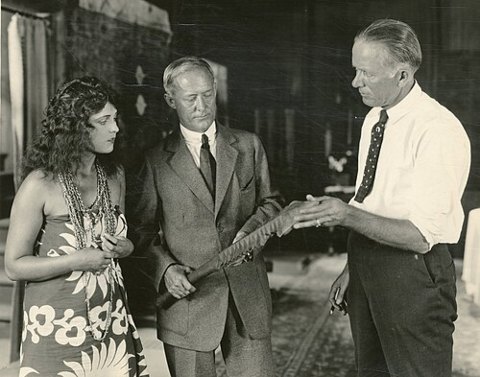
Frederick O'Brien (16 June 1869 – 9 January 1932) was an American author, journalist, hobo, peripatetic world traveler, and public administrator. He wrote three best-selling travel books about French Polynesia between 1919 and 1922: White Shadows in the South Seas, Mystic Isles of the South Seas, and Atolls of the Sun. A movie was made in 1928 of White Shadows in the South Seas.
Early life
Frederick O'Brien was born in 1869 in Baltimore into a comfortable Irish Catholic family. Family beliefs tended to leftist activism and outrage over social injustice. He referred to his devout sister Mary as a Catholic Trotskyite for her radicalism. Following three years at Loyola Jesuit College, he dropped out to travel. He spent 1887 exploring Venezuela and Brazil by foot, and worked in asphalt pits in Trinidad. Returning home, he studied law briefly, "plodding through irksome duties as a law clerk." Setting out again as a self-proclaimed hobo, he traveled throughout the States. He worked as a reporter for future U.S. president Warren Harding's newspaper in Marion, Ohio. In 1894 he was a general in Coxey's Army of the unemployed and its march on Washington, D.C. On May 26, 1897, in Chicago, Illinois he married Gertude Harriman Frye. They had no children and soon lived apart.
Career
After Coxey's Army, O'Brien worked mostly as an "accomplished, though itinerant, journalist." He continued to travel about the world. He worked for the Columbus (Ohio) Dispatch, filed articles with such outlets as The Honolulu Advertiser and the San Francisco Chronicle. From 1902 to 1909 he was editor of Cablenews-American in Manila. From 1903 to 1909 he was the East Asian correspondent for the New York Herald, covering events such as the Russo-Japanese War. In 1906–1907, he traveled to Europe, Africa, and Central and South America. His experiences led him to advocate for Philippine Independence and to become anti-imperialistic, opposing U.S. imperial ambitions in the Philippines and Latin America. Returning to California in 1909, he edited newspapers in Riverside and Oxnard, California. In 1913, he journeyed to the remote Marquesas Islands where he spent a year as a beachcomber. Returning to the United States, he served during World War I for the State Food Administration in California and the United States Food Administration in Washington, D.C., working under Herbert Hoover. In 1918-1919 he returned to Manila as publisher of the Manila Times. He visited Tahiti and Samoa in 1921 researching for his next book.