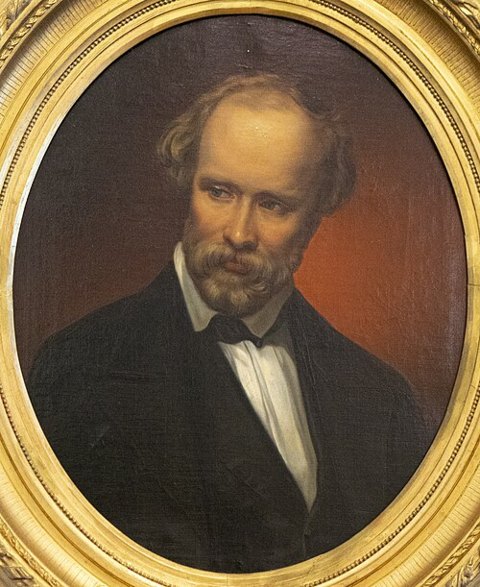
Christian Friedrich Hebbel (18 March 1813 – 13 December 1863) was a German poet and dramatist.
Biography
Hebbel was born at Wesselburen in Dithmarschen, Holstein, the son of a bricklayer. He was educated at the Gelehrtenschule des Johanneums, a grammar school in Hamburg, Germany. Despite his humble origins, he showed a talent for poetry, resulting in the publication in the Hamburg Modezeitung of verses which he had sent to Amalie Schoppe (1791–1858), a popular journalist and author of nursery tales. Through her patronage, he was able to go to the University of Hamburg.
A year later he went to Heidelberg University to study law, but gave it up and went on to the Ludwig-Maximilians-Universität München, where he devoted himself to philosophy, history and literature. In 1839, Hebbel left Munich and walked all the way back to Hamburg, where he resumed his friendship with Elise Lensing, whose self-sacrificing assistance had helped him over the darkest days in Munich. In the same year, he wrote his first tragedy, Judith (1840, published 1841), which was performed in Hamburg and Berlin the following year, making his name known throughout Germany.
In 1840, he wrote the tragedy Genoveva, and the following year he completed a comedy, Der Diamant, which he had begun at Munich. In 1842, he visited Copenhagen, where he obtained from King Christian VIII a small traveling stipend, which enabled him to spend time in Paris and two years (1844 to 1846) in Italy. In Paris, he wrote the "tragedy of common life," Maria Magdalena (1844). On his return from Italy, Hebbel met in Vienna two Prussian noblemen of the Zerboni di Sposetti family, who in their enthusiasm for his genius urged him to remain, providing financial support that allowed him to mingle in the best intellectual society of the Austrian capital.