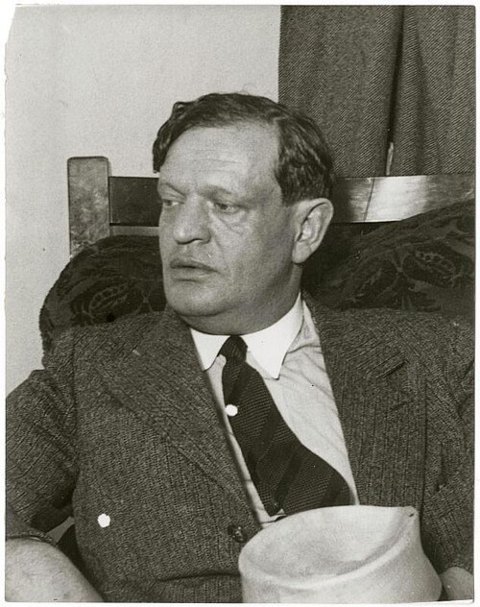
Frigyes Karinthy (Hungarian: [ˈfriɟɛʃ ˈkɒrinti]; 25 June 1887 – 29 August 1938) was a Hungarian author, playwright, poet, journalist, and translator. He was the first proponent of the six degrees of separation concept, in his 1929 short story, Chains (Láncszemek). Karinthy remains one of the most popular Hungarian writers. He was the brother of artist Ada Karinthy and the father of poet Gábor Karinthy and writer Ferenc Karinthy.
Among the English translations of Karinthy's works are two science fiction novellas that continue the adventures of Swift's character Gulliver. Voyage to Faremido is an early examination of artificial intelligence, with
a pacifist theme, while Capillaria is a polished and darkly humorous satire on the 'battle of the sexes'.
Life and work
Karinthy was born into a bourgeois family in Budapest. His family was originally Jewish but converted to Lutheranism shortly before he was born. He started his writing career as a journalist and remained a writer of short, humorous blurbs until his death. He rose to instant fame in 1912 with the publication of his literary parodies called Here's How YOU Write (Így írtok ti) in which he parodied the style of his fellow authors. He expanded the collection continuously during the following years. Among his early works, his collection of short stories from school life, Please Sir! (Tanár úr, kérem, 1916) also stands out for its grasp of the trials and tribulations of the average schoolboy. Karinthy was an admirer of H. G. Wells. In addition to translating Wells' The Country of the Blind and The Sea Lady into Hungarian, Karinthy's own fiction was influenced by Wells. Another popular highlight is his translation of A. A. Milne's Winnie the Pooh, that made it a cult book in Hungary. His translations are actually collaborations with her sister, Emilia. Frigyes didn't speak any languages besides Hungarian while Emilia spoke about 15-20 and she created raw translations which Frigyes rewrote according to the grandson of Frigyes. Emilia suffered from severe mental health problems and most people wasn't even aware of her existence and there are no known photos of her. Her diminutive name was Mici which can be found in the Hungarian title of Winnie the Pooh: Micimackó.