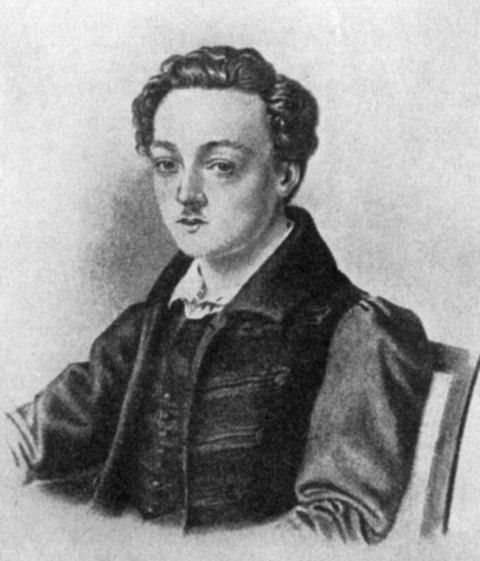
Karl Georg Büchner (17 October 1813 – 19 February 1837) was a German dramatist and writer of poetry and prose, considered part of the Young Germany movement. He was also a revolutionary and the brother of physician and philosopher Ludwig Büchner. His literary achievements, though limited by his death at age 23, are generally held in great esteem in Germany. Despite his brief career, his plays profoundly influenced naturalism, expressionism, and later developments in European theater.
At the age of 21, Büchner, with others, wrote a pamphlet entitled The Hessian Courier that has been called the most revolutionary manifesto of the nineteenth century before The Communist Manifesto.
Life and career
Born in Goddelau (now part of Riedstadt) in the Grand Duchy of Hesse as the son of a physician, Büchner attended the Darmstadt gymnasium, a humanistic secondary school.
In 1828, he became interested in politics and joined a circle of William Shakespeare aficionados, which later on probably became the Giessen and Darmstadt section of the Society for Human Rights (Gesellschaft für Menschenrechte).
In 1831, at age 18, he began to study medicine in Strasbourg. In Strasbourg, he immersed himself in French literature and political thought. He was influenced by the utopian communist theories of François-Noël Babeuf and Claude Henri de Saint-Simon. In 1833, he moved to Giessen and continued his studies at the local university.
While Büchner continued his studies in Giessen, he established a secret society dedicated to the revolutionary cause. In July 1834, with the help of evangelical theologian Friedrich Ludwig Weidig, he published the leaflet Der Hessische Landbote (The Hessian Courier), a revolutionary pamphlet critical of social injustice in the Grand Duchy of Hesse. The authorities charged them with treason and issued a warrant for their arrest. Weidig was arrested, tortured and later died in prison in Darmstadt; Büchner managed to flee across the border to Strasbourg, where he wrote most of his literary work and translated two French plays by Victor Hugo, Lucrèce Borgia and Marie Tudor. Two years later, his medical dissertation, "Mémoire sur le Système Nerveux du Barbeau (Cyprinus barbus L.)" was published in Paris and Strasbourg. In October 1836, after receiving his M.D. and being appointed by the University of Zürich as a lecturer in anatomy, Büchner relocated to Zürich, where he spent his final months writing and teaching until his death from typhus at the age of twenty-three.