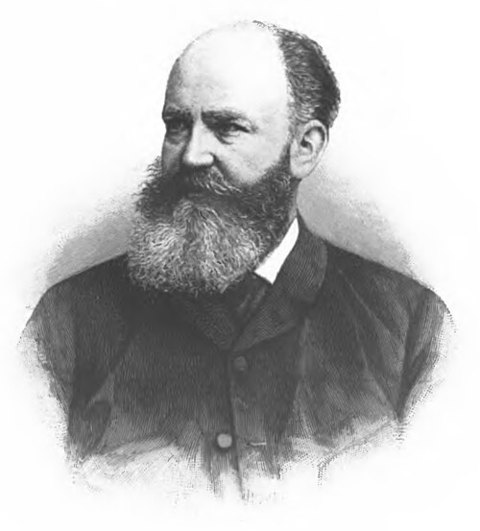
Georg Moritz Ebers (1 March 1837 – 7 August 1898) was a German Egyptologist and novelist. He is best known for his purchase of the Ebers Papyrus, one of the oldest Egyptian medical documents in the world.
Life
Georg Ebers was born in Berlin and was the youngest of the five children of an affluent family of bankers and porcelain manufacturers. The Ebers children were raised by their mother on her own, after their father committed suicide shortly after Ebers was born. His mother ran a salon popular among members of the intelligentsia, which included Georg Wilhelm Friedrich Hegel, the Grimm Brothers, and Alexander von Humboldt.
At Göttingen, Ebers studied jurisprudence, and at Berlin Oriental languages and archaeology. Having made a special study of Egyptology, he became in 1865 Dozent in Egyptian language and antiquities at Jena, becoming a professor in 1868. In 1870 he was appointed professor in these subjects at Leipzig. He had made two scientific journeys to Egypt, and his first work of importance, Ägypten und die Bücher Moses, appeared in 1867–1868. In 1874 he edited the celebrated medical papyrus (Papyrus Ebers), which he had discovered in Thebes (translation by H. Joachim, 1890).
Ebers early conceived the idea of popularising Egyptian lore by means of historical romances. Eine ägyptische Königstochter (An Egyptian Princess) was published in 1864 and obtained great success. His subsequent works of the same kind—Uarda (1877), Homo sum (1878), Die Schwestern (1880), Der Kaiser (1881), of which the scene is laid in Egypt at the time of Hadrian, Serapis (1885), Die Nilbraut (1887), and Kleopatra (1894)—were also well received and did much to make the public familiar with the discoveries of Egyptologists. Ebers also turned his attention to other fields of historical fiction—especially the 16th century (Die Frau Bürgermeisterin, 1882; Die Gred, 1887)—without, however, attaining the success of his Egyptian novels.