Autobiography of Sir George Biddell Airy
Online reading View book
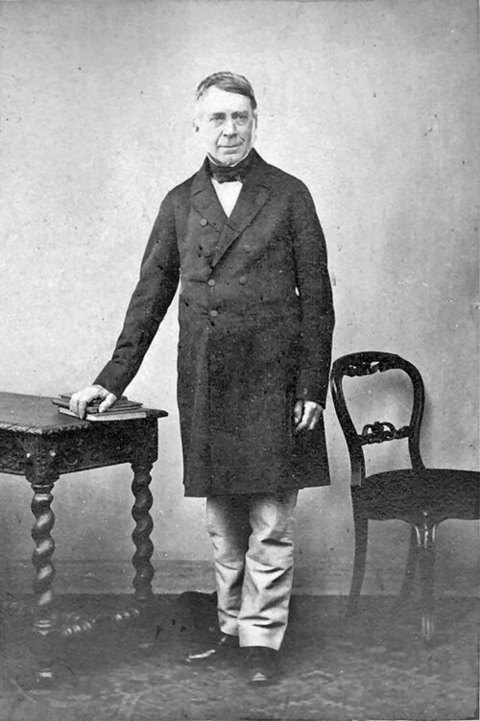
Author
English mathematician and astronomer (*1801 – †1892)
Sir George Biddell Airy (27 July 1801 – 2 January 1892) was an English mathematician and astronomer, as well as the Lucasian Professor of Mathematics from 1826 to 1828 and the seventh Astronomer Royal from 1835 to 1881. His many achievements include work on planetary orbits, measuring the mean density of the Earth, a method of solution of two-dimensional problems in solid mechanics and, in his role as Astronomer Royal, establishing Greenwich as the location of the prime meridian.
Airy was born at Alnwick in Northumberland, one of a long line of Airys who traced their descent back to a family of the same name residing at Kentmere, in Westmorland, in the 14th century. The branch to which he belonged, having suffered in the English Civil War, moved to Lincolnshire and became farmers. Airy was educated first at elementary schools in Hereford, and afterwards at Colchester Royal Grammar School. An introverted child, Airy gained popularity with his schoolmates through his great skill in the construction of peashooters.
From the age of 13, Airy stayed frequently with his uncle, Arthur Biddell at Playford, Suffolk. Biddell introduced Airy to his friend Thomas Clarkson, the slave trade abolitionist who lived at Playford Hall. Clarkson had an MA in mathematics from Cambridge, and examined Airy in classics and then subsequently arranged for him to be examined by a Fellow from Trinity College, Cambridge on his knowledge of mathematics. As a result, he entered Trinity in 1819, as a sizar, meaning that he paid a reduced fee but essentially worked as a servant to make good the fee reduction. Here he had a brilliant career, and seems to have been almost immediately recognised as the leading man of his year. In 1822 he was elected scholar of Trinity, and in the following year he graduated as senior wrangler and obtained first Smith's Prize. On 1 October 1824 he was elected fellow of Trinity, and in December 1826 was appointed Lucasian professor of mathematics in succession to Thomas Turton. This chair he held for little more than a year, being elected in February 1828 Plumian professor of astronomy and director of the new Cambridge Observatory. In 1836 he was elected a Fellow of the Royal Society and in 1840, a foreign member of the Royal Swedish Academy of Sciences. In 1859 he became foreign member of the Royal Netherlands Academy of Arts and Sciences.
Text: “George Biddell Airy”, from Wikipedia, the free encyclopedia, under the license CC BY-SA 4.0. Dates and facts: Wikidata.
Collection
1 book