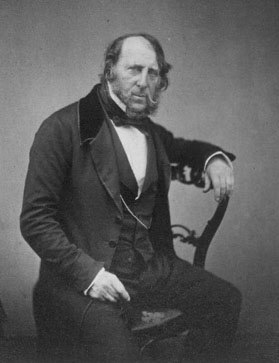
George Cruikshank or Cruickshank (KRUUK-shank; 27 September 1792 – 1 February 1878) was a British caricaturist and book illustrator, praised as the "modern Hogarth" during his life. His book illustrations for his friend Charles Dickens, and many other authors, reached an international audience.
Early life
Cruikshank was born in London. His father, Edinburgh-born Isaac Cruikshank, was one of the leading caricaturists of the late 1790s and Cruikshank started his career as his father's apprentice and assistant. His older brother, Isaac Robert, also followed in the family business as a caricaturist and illustrator.
Cruikshank's early work was caricature; but in 1823, at the age of 31, he started to focus on book illustration. He illustrated the first, 1823 English translation (by Edgar Taylor and David Jardine) of Grimms' Fairy Tales, published in two volumes as German Popular Stories.
On 16 October 1827, he married Mary Ann Walker (1807–1849). Two years after her death, on 7 March 1851, he married Eliza Widdison. The two lived at 263 Hampstead Road, north London.
Cruikshank had fathered 11 illegitimate children with a mistress named Adelaide Attree, his former servant, who lived close to where he lived with his wife. Adelaide was ostensibly married and had taken the married surname 'Archibold'.
Sociopolitical caricatures and illustrations
Cruikshank's early career was renowned for his social caricatures of English life for popular publications. He achieved early success collaborating with William Hone in his political satire The Political House That Jack Built (1819). In the same year he produced the now-infamous anti-abolitionist piece The New Union Club. It satirised a dinner party organised by abolitionists with black guests. While this piece was praised as "the finest of G.C.'s caricatures" during the 19th century, it is now viewed as one of the most racist prints of its era. His 1819 print, The Belle Alliance, or the Female Reformers of Blackburn!!!, criticised the role of women in the reform movement, portraying them as unfeminine and grotesque.His first major work was Pierce Egan's Life in London (1821) in which the characters Tom and Jerry, two 'men about town' visit various London locations and taverns to enjoy themselves and carouse. This was followed by The Comic Almanack (1835–1853) and Omnibus (1842). Cruikshank gained notoriety with his political prints that attacked the royal family and leading politicians. In 1820 he received a royal bribe of £100 for a pledge "not to caricature His Majesty" (George IV) "in any immoral situation". His work included a personification of England named John Bull who was developed from about 1790 in conjunction with other British satirical artists such as James Gillray, and Thomas Rowlandson.