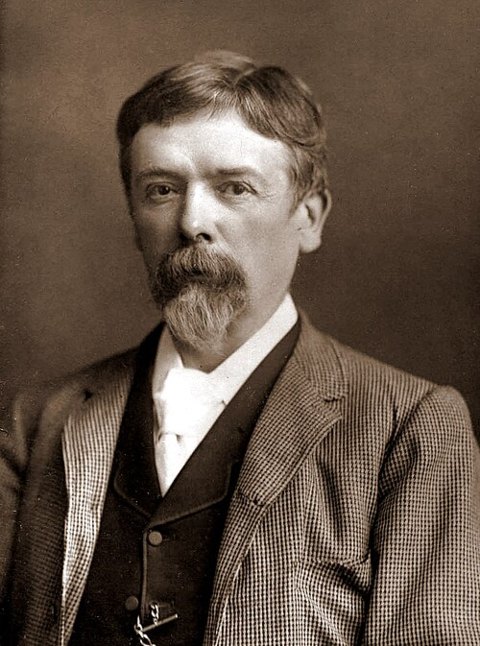
George Louis Palmella Busson du Maurier (French: [dy mɔʁje]; 6 March 1834 – 8 October 1896) was a French-British cartoonist, illustrator, and novelist. His first novel Peter Ibbetson was published in 1891 and has been adapted into films, an opera, and a play. He was known for his work in Punch and his 1894 Gothic novel Trilby, featuring the character Svengali.
His son was the actor Sir Gerald du Maurier. The writers Angela du Maurier and Daphne du Maurier and the artist Jeanne du Maurier were all granddaughters of George. He was also father of Sylvia Llewelyn Davies and grandfather of the five boys who inspired J. M. Barrie's Peter Pan.
Early life
George du Maurier was born in Paris, son of Louis-Mathurin Busson du Maurier and wife Ellen Clarke, daughter of the Regency courtesan Mary Anne Clarke. He was brought up to believe his aristocratic grandparents had fled from France during the Revolution, leaving vast estates behind, to live in England as émigrés. In fact, du Maurier's grandfather, Robert-Mathurin Busson, was a tradesman who left Paris in 1789 to avoid charges of fraud and later changed the family name to the grander-sounding du Maurier.
Du Maurier studied art in Paris, in the studio of Charles Gleyre, and moved to Antwerp, where he lost the vision in his left eye. He was reportedly studying chemistry at University College, London, in 1851. He is recorded in the 1861 England Census as a lodger at 85 Newman St in Marylebone.
Cartoonist
Du Maurier became a member of staff at the British satirical magazine Punch in 1865, drawing two cartoons a week. His commonest targets were the affected manners of Victorian society, the bourgeoisie and members of Britain's growing middle class in particular. His most enduring cartoon, True Humility (1895), popularised the expressions "good in parts" and "a curate's egg". In it, a bishop addresses a humble curate, whom he has invited to breakfast: "I'm afraid you've got a bad egg, Mr. Jones." The curate replies, "Oh no, my Lord, I assure you – parts of it are excellent!" The gag was not original to du Maurier, however, as it had appeared in a similar cartoon a few months earlier in Judy, a less widely read competitor to Punch. In an earlier (1884) cartoon, du Maurier coined the expression "bedside manner", with which he satirised medical care. Another of his notable cartoons depicted a fanciful videophone conversation in 1879, using a device he called "Edison's telephonoscope".