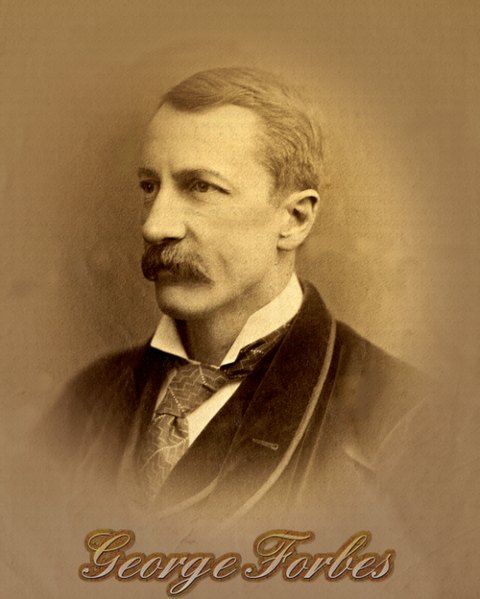
George Forbes (5 April 1849 – 22 October 1936) was a Scottish electrical engineer, astronomer, explorer, author and inventor, some of whose inventions are still in use.
Early life
Born at 3 Park Place in Edinburgh on 5 April 1849, Forbes was the second son of James David Forbes and Alicia Wauchope. His father was later Principal of St Andrews University. Forbes was educated at Edinburgh Academy, the University of St Andrews, Christ's College and St Catharine's College, Cambridge.
Career
In 1873 he was appointed Professor of Natural Philosophy at Anderson's University, Glasgow, (the nucleus of the University of Strathclyde). In his lectures he advocated using electricity to power transportation. His main work at this time, however, was research into the velocity of light.
Arguably his most important work was as a supervising engineer for several pioneering hydroelectric schemes. From 1891 to 1895, Forbes was consulting engineer on the Niagara Falls hydroelectric scheme. He also advised on other schemes, in India (1893), South Africa (1895), New Zealand (1896) and Egypt (1898).
In 1880 Forbes resigned from Anderson's University and moved to London. For the next two decades he devoted himself to electrical power engineering. Commissioned to report on how the City and South London Railway should be powered, he recommended electricity. Soon the entire London Underground would follow his advice. In 1881 he served as a juror at the Paris Exposition Internationale d'Electricite. He was subsequently admitted to the French Legion of Honour.