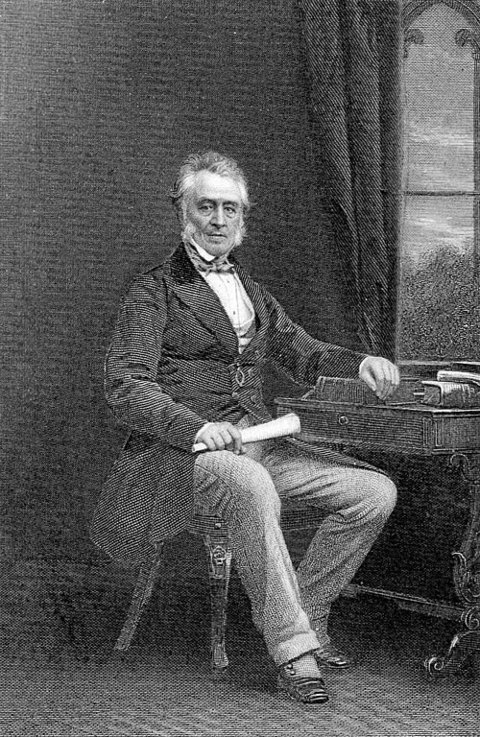
George Grote (17 November 1794 – 18 June 1871) was an English political radical and classical historian. He is now best known for his major work, the voluminous History of Greece.
Early life
George Grote was born at Clay Hill near Beckenham in Kent. His grandfather, Andreas, originally a Bremen merchant, was one of the founders (on 1 January 1766) of the banking-house of Grote, Prescott & Company in Threadneedle Street, London (the name of Grote did not disappear from the firm until 1879). His father, another George, married (1793) Selina, daughter of Henry Peckwell (1747–1787), minister of Selina, Countess of Huntingdon's chapel in Westminster, and his wife Bella Blosset (descended from a Huguenot officer Salomon Blosset de Loche who left the Dauphiné on the revocation of the Edict of Nantes), and had one daughter and ten sons, of whom George was the eldest. His brothers were the moral philosopher John Grote and the colonial administrator Arthur Grote. (John Russell RA painted portraits of Henry Peckwell and Bella Blosset.)
Educated at first by his mother, George Grote was sent to Sevenoaks grammar school (1800–1804) and afterwards to Charterhouse School (1804–1810), where he studied under Dr Raine in company with Connop Thirlwall, George and Horace Waddington and Henry Havelock. In spite of Grote's school successes, his father refused to send him to university and sent him to work at the bank. He spent all his spare time in the study of classics, history, metaphysics and political economy and in learning German, French and Italian. Driven by his mother's Puritanism and his father's contempt for academic learning, he sought other friends, one of whom was Charles Hay Cameron, who strengthened him in his love of philosophy.