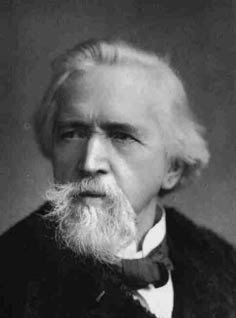
George Jacob Holyoake (13 April 1817 – 22 January 1906) was an English secularist, co-operator and newspaper editor. He coined the terms secularism in 1851 and "jingoism" in 1878. He edited a secularist paper, The Reasoner, from 1846 to June 1861, and a co-operative one, The English Leader, in 1864–1867.
Early life
George Jacob Holyoake was born in Birmingham, where his father worked as a whitesmith and his mother as a button maker. He attended a dame school and a Wesleyan Sunday School, began working half-days at the same foundry as his father at the age of eight, and learnt his trade. At 18 he began attending lectures at the Birmingham Mechanics' Institute, where he encountered the socialist writings of Robert Owen and later became an assistant lecturer. He married Eleanor Williams in 1839 and decided to become a full-time teacher, but was rejected for his socialist views. Unable to teach full-time, Holyoake took a job as an Owenite social missionary. His first posting was in Worcester, but the following year he was transferred to a more important one in Sheffield.
Owenism
Holyoake joined Charles Southwell in dissenting from the official Owenite policy that lecturers should take a religious oath to enable them to take collections on Sundays. Southwell had founded an atheist publication, Oracle of Reason, and was soon imprisoned on those grounds. Holyoake took over as editor, having moved to an atheist position as a result of his experiences.
Holyoake was influenced by the French philosopher of science, Auguste Comte, notable in sociology and famous for the doctrine of positivism. Comte had himself attempted to establish a secular "religion of humanity" to fulfil the cohesive function of traditional religion. Holyoake was an acquaintance of Harriet Martineau, who translated various works by Comte and was perhaps the first female sociologist. She wrote to him excitedly on reviewing Darwin's On the Origin of Species in 1859.