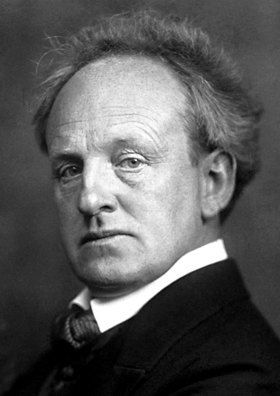
Gerhart Johann Robert Hauptmann (German: [ˈɡeːɐ̯haʁt ˈhaʊptman]; 15 November 1862 – 6 June 1946) was a German dramatist and novelist. He is counted among the most important promoters of literary naturalism, though he integrated other styles into his work as well. He received the Nobel Prize in Literature in 1912.
Childhood and youth
Gerhart Hauptmann was born in 1862 in Obersalzbrunn, now known as Szczawno-Zdrój, in Lower Silesia (then a part of the Kingdom of Prussia, now a part of Poland). His parents were Robert and Marie Hauptmann, who ran a hotel in the area. As a youth, Hauptmann had a reputation of being loose with the truth. His elder brother was Carl Hauptmann.
Beginning in 1868, he attended the village school and then, in 1874, the Realschule in Breslau for which he had only barely passed the qualifying exam. Hauptmann had difficulties adjusting himself to his new surroundings in the city. He lived, along with his brother Carl, in a somewhat run-down student boarding house before finding lodging with a pastor.
He ran into problems with the Prussian-influenced school. Above all were the strictness of the teachers and the better treatment of his noble classmates. His dislike and numerous illnesses kept him from attending class, which led to his having to repeat his first year. Over time, he came to appreciate Breslau because of the opportunity to visit the theater.
In the spring of 1878, Hauptmann left the Realschule to learn agriculture on his uncle's farm in Lohnig (today Łagiewniki Średzkie in Gmina Udanin, Poland). After a year and a half, however, he had to break off his training. He was not physically prepared for the work and he had contracted a life-threatening lung ailment that troubled him for the next twenty months.