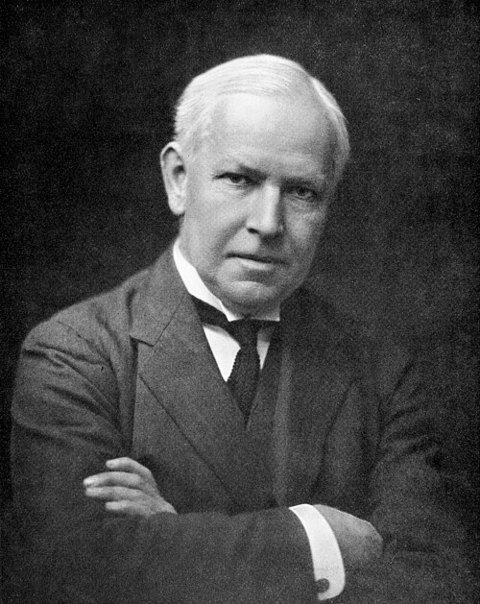
Sir Grafton Elliot Smith (15 August 1871 – 1 January 1937) was an Australian-British anatomist, Egyptologist and a proponent of the hyperdiffusionist view of prehistory. He believed in the idea that cultural innovations occur only once and that they spread geographically. Based on this, he traced the origins of many cultural and traditional practices across the world, including the New World, to ideas that he believed came from Egypt and in some instances from Asia. An expert on brain anatomy, he was one of the first to study Egyptian mummies using radiological techniques. He took an interest in extinct humanoids and was embroiled in controversy over the authenticity of the Piltdown Man.
Professional career
Smith was born in Grafton, New South Wales to Stephen Sheldrick Smith who had moved to Australia from London in 1860 and Mary Jane, née Evans. He received his early education from Grafton Public School where his father was headmaster. When the family moved to Sydney in 1883 he went to Darlington Public School before joining Sydney Boys High School. He attended evening classes on physiology by Thomas Anderson Stuart and took an early interest in biology. In an autobiographical note Smith noted that Stuart had shown them the convolutions of the human brain and declared that nobody understood them fully. Smith decided at that point that he would work towards understanding them. Accordingly, he went to study medicine at the University of Sydney in 1888 and received a Doctor of Medicine in 1895, with a dissertation on the fore-brain of the monotremes) and developed an interest in the anatomy of the human brain. He received a James King travelling scholarship and went to St John's College, Cambridge, graduating BA in 1896. Afterwards he catalogued the human brain-collection of the British Museum.