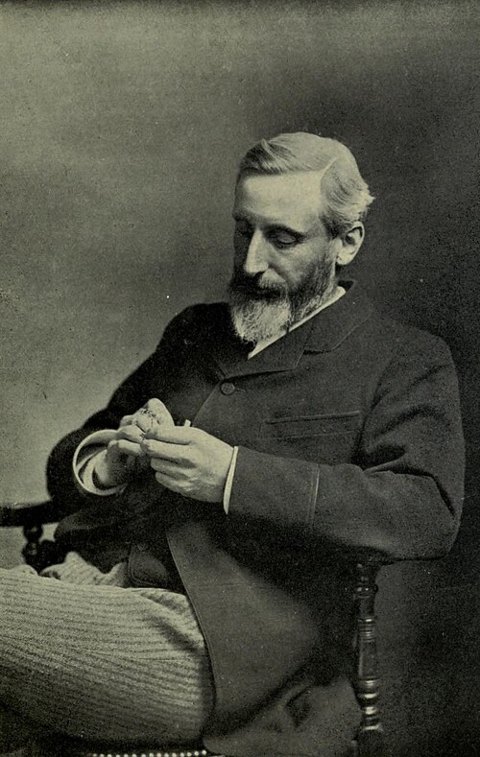
Charles Grant Blairfindie Allen (February 24, 1848 – October 25, 1899) was a Canadian science writer and novelist, educated in England. He was a public promoter of evolution in the second half of the nineteenth century.
Early life, family and education
Allen was born on Wolfe Island near Kingston, Canada West (known as Ontario after Confederation), the second son of Catharine Ann Grant and the Rev. Joseph Antisell Allen, a Protestant minister from Dublin, Ireland. His mother was a daughter of the fifth Baron de Longueuil. Allen was educated at home until, at age 13, he and his parents moved to the United States, then to France, and finally to the United Kingdom. He was educated in the UK: at King Edward's School in Birmingham and at Merton College in Oxford.
After graduation, Allen studied in France.
Instructor
Allen taught at Brighton College in 1870–71. In his mid-twenties, he became a professor at Queen's College, a black college in Jamaica. Despite being the son of a minister, Allen became an atheist and a socialist.
Writer
After leaving his professorship, in 1876 he returned to England, where he turned his talents to writing, gaining a reputation for his essays on science and for literary works. A 2007 book by Oliver Sacks cites with approval one of Allen's early articles, "Note-Deafness" (a description of what became known as amusia, published in 1878 in the learned journal Mind).
Allen's first books dealt with scientific subjects, and include Physiological Æsthetics (1877) and Flowers and Their Pedigrees (1886) He was first influenced by associationist psychology as expounded by Alexander Bain and by Herbert Spencer, the latter who especially espoused the transition from associationist psychology to Darwinian functionalism. In Allen's many articles on flowers and on perception in insects, Darwinian arguments replaced the old Spencerian terms. Allen argued that evolution in color sense linked flowers to insects and birds, and mammals to humans. This led to a radically new vision of plant life that influenced H.G. Wells and helped transform later botanical research. The 1892 edition of the book was supported by both Darwin and Spencer. It attacked Hugo Magnus’s idea that color sense had developed in historical times due to old literature only having simple color names.