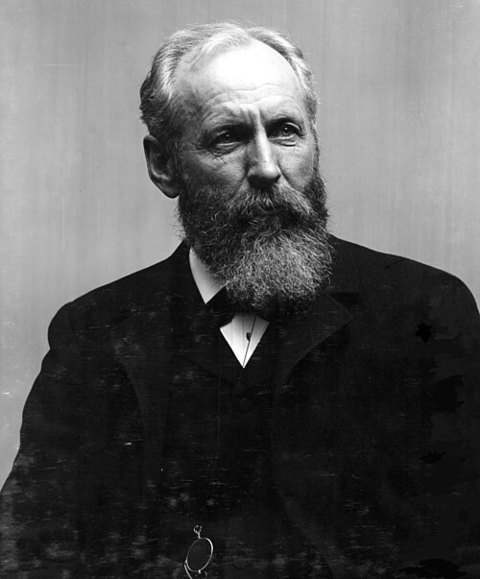
Grove Karl Gilbert (May 6, 1843 – May 1, 1918), known by the abbreviated name G. K. Gilbert in academic literature, was an American geologist.
Biography
Gilbert was born in Rochester, New York, the youngest of three kids of the painter Grove Sheldon Gilbert, and his wife, Eliza. He graduated from the University of Rochester. During the American Civil War, he was twice listed for the draft, but his name was drawn neither time. In 1871, he joined George M. Wheeler's geographical survey as its first geologist.
Rockies geologist
Gilbert joined the Powell Survey of the Rocky Mountain Region in 1874, becoming Powell's primary assistant, and stayed with the survey until 1879. During this time he published an important monograph, The Geology of the Henry Mountains (1877). After the U.S. Geological Survey was created in 1879, he was appointed to the position of Senior Geologist and worked for the USGS until his death (including a term as acting director).
Gilbert published a study of the former ancient Lake Bonneville in 1890 (the lake existed during the Pleistocene), of which the Great Salt Lake is a remnant. He named it after the army captain Benjamin Bonneville, who had explored the region. The type of river delta that Gilbert described at this location has since become known to geomorphologists as a Gilbert delta.
Meteor crater
In 1891, Gilbert examined the origins of a crater in Arizona, now known as Meteor Crater but then as Coon Butte. For several reasons, and against his intuition, he concluded it was the result of a volcanic steam explosion rather than an impact of a meteorite. Gilbert based his conclusion on the beliefs that the volume of an impact crater including the meteorite should be more than the ejected material on the rim and that, if it was a meteorite, iron should create magnetic anomalies. Gilbert's calculations showed that the crater's volume and the debris on the rim were roughly equal, and that there were no magnetic anomalies. He argued that the meteorite fragments found on the rim were just "coincidence". In 1892, Gilbert delivered his paper "The Moon's Face; A Study of the Origin of Its Features" as his retiring President's lecture to the Philosophical Society of Washington, and it was published in the Society's bulletin. He publicized these conclusions in a series of lectures in 1895. Later investigations revealed that it was in fact a meteor crater, but that interpretation was not well established until the mid-20th century. As part of his interest in crater origins, Gilbert also studied the moon's craters and concluded they were caused by impact events rather than volcanoes, although he wondered why the craters were round and not oval as expected for an oblique impact. The interpretation of lunar craters as of impact origin was also debated until the mid-20th century.