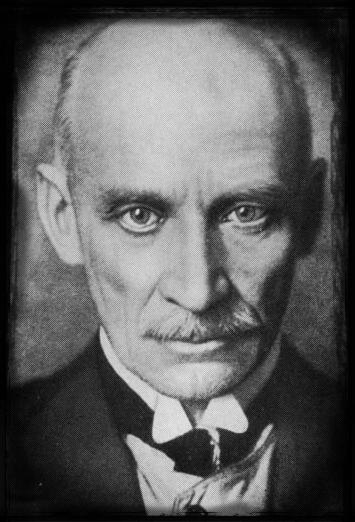
Gustav Meyrink (19 January 1868 – 4 December 1932) was the pseudonym of Gustav Meyer, an Austrian author,
novelist, dramatist, translator, and banker, most famous for his novel The Golem.
He has been described as the "most respected German language writer in the field of supernatural fiction".
Childhood
Gustav Meyrink was born with the name Gustav Meyer in Vienna, Austria-Hungary (now Austria) on 19 January 1868. He was the illegitimate son of Baron Karl von Varnbüler und zu Hemmingen, a Württembergian minister, and actress Maria Wilhelmina Adelheid Meier. Meyrink was not, despite the statements of some of his contemporaries, of Jewish descent – this rumor arose due to a confusion of his mother with a Jewish woman of the same name.
Until thirteen years of age Meyrink lived mainly in Munich, where he completed elementary school. He then stayed in Hamburg for a brief time, until his mother relocated to Prague in 1883.
Prague
Meyrink lived in Prague for twenty years and has depicted it many times in his works. In 1889, together with the nephew of poet Christian Morgenstern, Meyrink established his own banking company, named "Meier & Morgenstern".
In Prague an event occurred which played a providential role in Meyrink's life. Meyrink described it in the autobiographical short story "The Pilot". That day, 14 August 1892, on Assumption Eve, Meyrink, twenty-four years old, was allegedly standing at his table with a gun at his head, determined to shoot himself. At that moment he heard a strange scratching sound and someone's hand put a tiny booklet under his door. The booklet was called Afterlife. Meyrink was surprised by this dramatic coincidence and started to study the literature of the occult. He studied theosophy, Kabbala, Christian Sophiology and Eastern mysticism. Until his death Meyrink practiced yoga and other occult exercises. Results of these studies and practices are found in Meyrink's works, which almost always deal with various occult traditions.