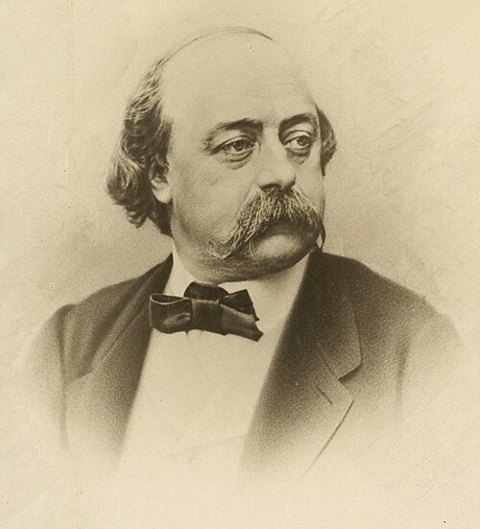
Gustave Flaubert (UK: FLOH-bair, US: floh-BAIR; French: [ɡystav flobɛʁ]; 12 December 1821 – 8 May 1880) was a French novelist. He has been considered the leading exponent of literary realism in his country and abroad. He is known especially for his debut novel Madame Bovary (1857), his Correspondence, and his scrupulous devotion to his style and aesthetics. The celebrated writer Guy de Maupassant was a protégé of Flaubert.
Early life and education
Flaubert was born in Rouen, in the Seine-Maritime department of Upper Normandy, in northern France. He was the second son of Anne Justine Caroline (née Fleuriot; 1793–1872) and Achille-Cléophas Flaubert (1784–1846), director and senior surgeon of the major hospital in Rouen. He began writing at an early age, as early as eight according to some sources.
He was educated at the Lycée Pierre-Corneille in Rouen, and did not leave until 1840, whereupon he went to Paris to study law. In Paris, he was an indifferent student and found the city distasteful. He made a few acquaintances, including Victor Hugo. Toward the end of 1840, he traveled in the Pyrenees and Corsica. In 1846, after an attack of epilepsy, he left Paris and abandoned the study of law.
Career
His first finished work was November, a novella, which was completed in 1842.
In September 1849, Flaubert completed the first version of a novel, The Temptation of Saint Anthony. He read the novel aloud to Louis Bouilhet and Maxime Du Camp over the course of four days, not allowing them to interrupt or give any opinions. At the end of the reading, his friends told him to throw the manuscript in the fire, suggesting instead that he focus on day-to-day life rather than fantastic subjects.