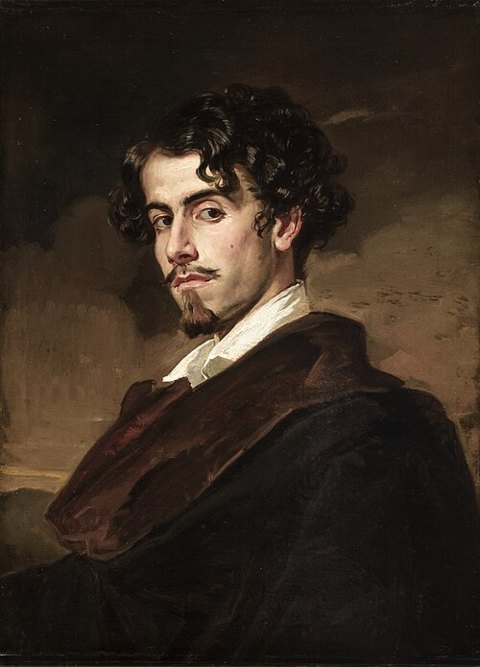
Gustavo Adolfo Claudio Domínguez Bastida (17 February 1836 – 22 December 1870), better known as Gustavo Adolfo Bécquer (Spanish pronunciation: [ɡusˈtaβo aˈðolfo ˈβekeɾ]), was a Spanish Romantic poet and writer (mostly short stories), also a playwright, literary columnist, and talented in drawing. He is one of the most important figures in Spanish literature, with some considering him the most read Spanish writer after Miguel de Cervantes. He adopted the alias of Bécquer as his brother Valeriano Bécquer, a painter, had done earlier. He was associated with the romanticism and post-romanticism movements and wrote while realism enjoyed success in Spain. He was moderately well-known during his life, but it was after his death that most of his works were published. His best-known works are the Rhymes and the Legends, usually published together as Rimas y leyendas. These poems and tales are essential to studying Spanish literature and common reading for high-school students in Spanish-speaking countries.
His work approached the traditional poetry and themes in a modern way, and he is considered the founder of modern Spanish lyricism. Bécquer's influence on 20th-century poets of the Spanish language can be felt in the works of Luis Cernuda, Octavio Paz, Giannina Braschi, Antonio Machado, and Juan Ramón Jiménez. Bécquer himself was influenced – both directly and indirectly — by Cervantes, Shakespeare, Goethe, and Heinrich Heine.