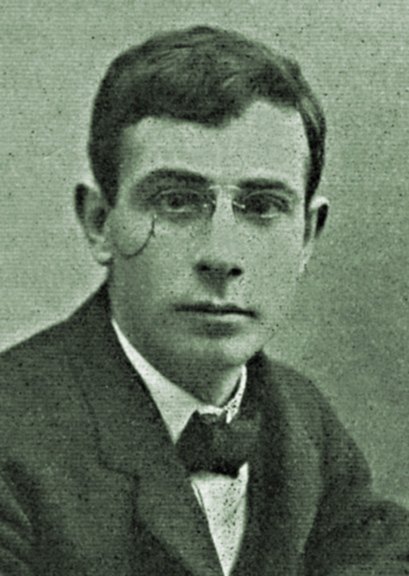
Gustavus Myers (March 20, 1872 – 1942) was an American journalist and historian who published a series of highly critical and influential studies on the social costs of wealth accumulation.
The Gustavus Myers Outstanding Book Award was named after him, which honoured books which were judged to be "outstanding in helping shed light on bigotry in America".
Childhood and family
Gustavus Myers was born March 20, 1872, in Trenton, New Jersey, the son of Julia Hillman and Abram Myers. He attended school for a time while the impoverished family lived in Philadelphia. His father was largely absent. At the age of 14 Myers began working in a factory. He continued his own education by reading avidly and attending public lectures. His older brother Jerome Myers became a painter associated with the Ashcan School. Gustavus married Genevieve Whitne, Massachusetts, on September 23, 1904, and they had two children together (Marcella and Theo).
Career
In 1891, Myers went to work as a reporter for the Philadelphia Record, leaving the next year for New York City, where he remained for the rest of his life. In the 1890s, Myers became a member of the People's Party (commonly known as the "Populists"), later joining the Socialist Party of America (SPA).
He published 'The History of Tammany Hall' in 1901, and to explore his interest in parapsychology, Beyond the Borderline of Life in (1910). In the 1910s, he emerged as a leading scholar on American socialism by authoring a series of volumes for the Charles H. Kerr Publishing Company, the country's largest publisher of pamphlets and books on Marxism.