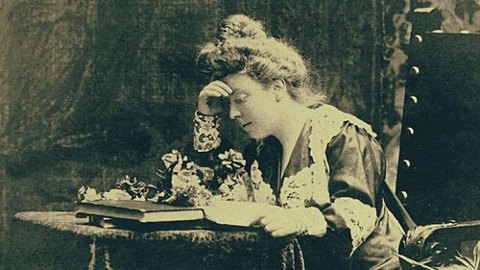
Hannah Lynch (25 March 1859 – 9 January 1904) was an Irish feminist, novelist, journalist and translator. She spent much of her working life in Paris.
Life
Hannah Lynch was born in Dublin on 25 March 1859. Her father died when she was young. Her mother was married twice. Her father was a committed, non-violent Fenian. Lynch herself grew up in a very female house with her mother, Anna Theresa Calderwood, and ten sisters and half-sisters. Her stepfather was James Cantwell, also a Fenian, who ran the Star and Garter Hotel. After finishing school Lynch worked as a sub-editor for a provincial paper and as a governess in Europe.
A nationalist like her father and stepfather, Lynch was an executive member of the Ladies' Land League and as a result closely associated with Fanny Parnell. She wrote extensively, producing short stories and satirical sketches, as well as Land War fiction, travel writing, translations and literary criticism. Her satirical pieces included "A Dublin Literary Coterie Sketched by a Non-Pretentious Observer" (1888) and "My Friend Arcanieva" (1895). Lynch published William O'Brien's paper United Ireland from France, once it had been suppressed in Ireland. She disagreed with Yeats on the literary merit of Emily Lawless, calling her work "highly polished literary stories".
Lynch also wrote fiction on the subject of political and cultural affairs in Ireland, sometimes meeting controversy. Her first novel, Through Troubled Waters (1885), was a fictionalised version of a real-life incident in Galway in which the daughters of a prosperous landowning family were murdered to make way for the sons to inherit the land. The novel also depicted the rural clergy as complicit, by denouncing the victims from the pulpit. The newspaper United Ireland strongly criticised the novel, claiming it peddled in anti-Irish stereotypes for a British audience. Lynch responded by stating that she had intended the book for an Irish publisher and audience, and that she should not be asked “to prove my patriotism at the expense of truth”.