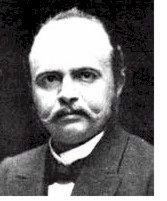
Hans Adolf Eduard Driesch (28 October 1867 – 17 April 1941) was a German biologist and philosopher from Bad Kreuznach. He is most noted for his early experimental work in embryology and for his neo-vitalist philosophy of entelechy. He has also been credited with performing the first artificial 'cloning' of an animal in the 1880s, although this claim is dependent on how one defines cloning.
Early years
Driesch was educated at the Gelehrtenschule des Johanneums. He began to study medicine in 1886 under August Weismann at the University of Freiburg. In 1887, he attended the University of Jena under Ernst Haeckel, Oscar Hertwig and Christian Ernst Stahl. In 1888, he studied physics and chemistry at the Ludwig-Maximilians-Universität München. He received his doctorate in 1889. He travelled widely on field and study trips and lecture-tours, visiting Plymouth, India, Zurich and Leipzig where, in 1894, he published his Analytische Theorie der organischen Entwicklung or Analytic Theory of Organic Development. His interests encompassed mathematics, philosophy and physics as well as biology. He married Margarete Relfferschneidt, and the couple had two children.
Experiments in embryology
From 1891, Driesch worked in Naples at the Marine Biological Station, where until 1901, he continued to experiment and seek a theoretical formulation of his results. He inquired into classical and modern philosophy in his search for an adequate theoretical overview and ended by adopting an Aristotelian teleological theory of entelechy.
Under the influence of his teacher Haeckel, Driesch had tested the mechanistic embryological theories of another of Haeckel's students, Wilhelm Roux. Driesch studied sea urchin embryos, and found that when he separated the two cells of the embryo after the first cell-division, each developed into a complete sea urchin. This was contrary to his expectation that each cell would develop into the corresponding half of the animal, a prediction based on Wilhelm Roux's earlier work with frog embryos. This also happened at the four-cell stage: entire larvae ensued from each of the four cells, albeit smaller than usual. By 1885, Driesch's experiments on the sea urchin embryo showed that it was even possible to shuffle the blastomeres of the early embryo without affecting the resulting larva.