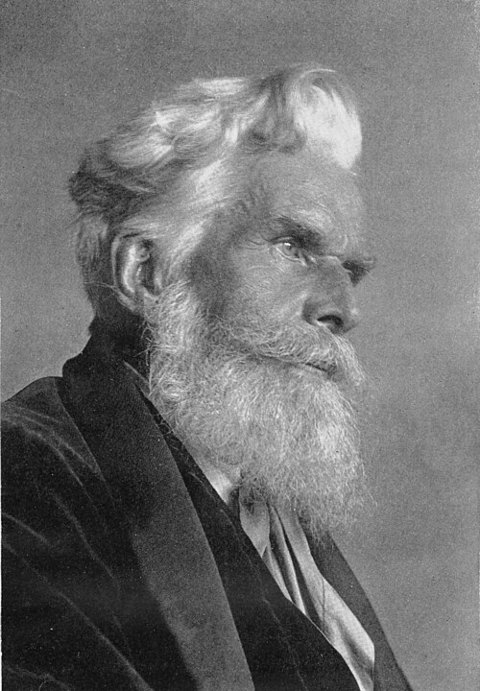
Henry Havelock Ellis (2 February 1859 – 8 July 1939) was an English physician, eugenicist, writer, progressive intellectual and social reformer who studied human sexuality. He co-wrote the first medical textbook in English on homosexuality in 1897, and also published works on a variety of sexual practices and inclinations, as well as on transgender psychology. He developed the notions of narcissism and autoeroticism, later adopted by psychoanalysis.
Ellis was among the pioneering investigators of psychedelic drugs and the author of one of the first written reports to the public about an experience with mescaline, which he conducted on himself in 1896. He supported eugenics and served as one of 16 vice-presidents of the Eugenics Society from 1909 to 1912.
Early life and career
Ellis, son of Edward Peppen Ellis and Susannah Mary Wheatley, was born in Croydon, Surrey (now part of Greater London). He had four sisters, none of whom married. His father was a sea captain and an Anglican, while his mother was the daughter of a sea captain who had many other relatives that lived on or near the sea. When he was seven his father took him on one of his voyages, during which they called at Sydney, Australia; Callao, Peru; and Antwerp, Belgium. After his return, Ellis attended the French and German College near Wimbledon, and afterward attended a school in Mitcham.
In April 1875, Ellis sailed on his father's ship for Australia; soon after his arrival in Sydney, he obtained a position as a master at a private school. After the discovery of his lack of training, he was fired and became a tutor for a family living a few miles from Carcoar, New South Wales. He spent a year there and then obtained a position as a master at a grammar school in Grafton, New South Wales. The headmaster had died and Ellis carried on at the school for that year, but was unsuccessful.