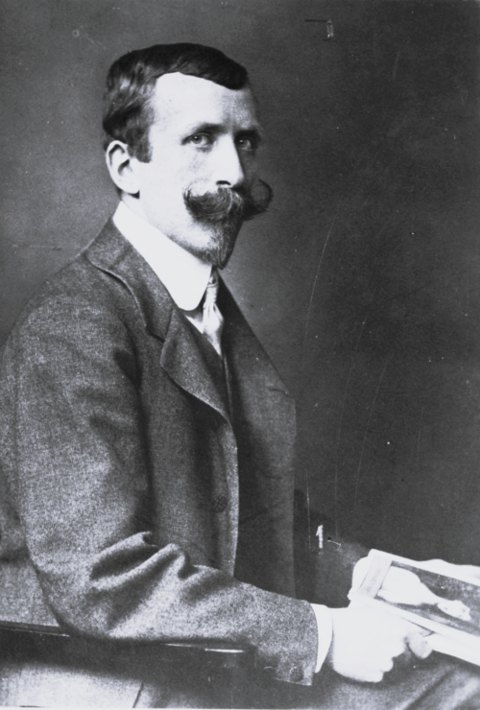
Luiz Heinrich Mann (German: [ˈhaɪnʁɪç ˈman]; March 27, 1871 – March 11, 1950), best known as simply Heinrich Mann, was a German-American writer known for his sociopolitical novels. From 1930 until 1933, he was president of the fine poetry division of the Prussian Academy of Arts. His fierce criticism of the growing Fascism and Nazism forced him to flee Germany after the Nazis came to power during 1933. He was the elder brother of writer Thomas Mann.
Early life
Born in Lübeck, as the first child of Senator Thomas Johann Heinrich Mann, grain merchant and finance minister of the Free City of Lübeck, a state of the German Empire, and Júlia da Silva Bruhns. He was the elder brother of the writer Thomas Mann with whom he had a lifelong rivalry. The Mann family was an affluent family of grain merchants of the Hanseatic city of Lübeck. After the death of his father, his mother relocated the family to Munich, where Heinrich began his career as a freier Schriftsteller (free writer). In 1914, he married a Czech actress, Maria "Mimi" Kanova. They divorced in 1930. Mimi, being Jewish, died from the consequences of a five-year detention in the concentration camp Theresienstadt.
Work and exile
Mann's essay on Émile Zola and the novel Der Untertan (published over the years 1912–1918) earned him much respect during the Weimar Republic in left-wing circles, since they demonstrated the author's antiwar and defeatist stance during World War I, while the latter satirized Imperial German society; both the novel and the essay became a major impulse for Thomas Mann to write Reflections of a Nonpolitical Man, a work supporting the efforts of the German Empire in the war and condemning Heinrich as one of "Civilisation's Literary Men" (Zivilisationsliteraten), the writers who served the West in its struggle against German culture; later Thomas called the novel an example of "national slander" and "ruthless aestheticism", yet the novel had admirers such as Kurt Tucholsky. During the revolution, Heinrich became a major supporter of Kurt Eisner, a social democrat revolutionary who proclaimed Bavaria a Socialist republic; after Eisner's assassination by a far-right activist, Mann spoke at Eisner's funeral.