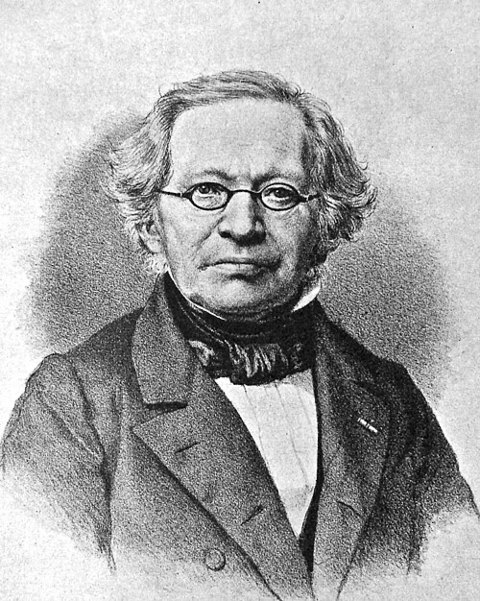
Henrik Hertz (25 August 1797 – 25 February 1870) was a Danish poet.
Biography
He was born of Jewish parents in Copenhagen. In 1817 he was sent to the university. His father died in his infancy, and the family property was destroyed in the bombardment of 1807. The boy was brought up by his relative M.L. Nathanson, a well-known newspaper editor.
Young Hertz passed his examination in law in 1825. He lived in the South of France. But his taste was all for literature, and in 1826-1827 two plays of his were produced, Hr. Burchardt og hans Familie (Mr. Burchardt and his Family) and Kjærlighed og Politi (Love and Policy); in 1828 followed the comedy of Flyttedagen (Moving Day). In 1830 he brought out what was a complete novelty in Danish literature, a comedy in rhymed verse, Amors Genistreger (Cupid's Strokes of Genius).
In the same year Hertz published anonymously Gjengangerbrevene (Letters from a Ghost), which he pretended were written by Jens Immanuel Baggesen, who had died in 1826. The book was written in defence of Johan Ludvig Heiberg, and was full of satirical humour and fine critical insight. Its success was overwhelming; but Hertz preserved his anonymity, and the secret was not known until many years later.
In 1832, he published a didactic poem, Naturen og Kunsten (Nature and Art), and Four Poetical Epistles. En Dag paa Øen Als (A Day on the Island of Als) was his next comedy, followed in 1835 by Den eneste Fejl (The Only Fault). Hertz passed through Germany and Switzerland into Italy in 1833; he spent the winter there, and returned the following autumn through France to Denmark.