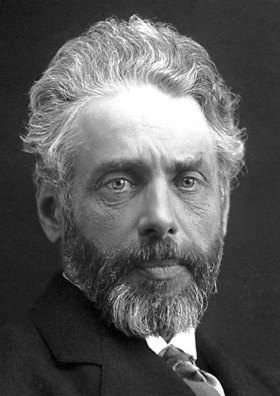
Henrik Pontoppidan (Danish: [ˈhenˀʁek pʰʌnˈtsʰʌpitæn]; 24 July 1857 – 21 August 1943) was a Danish realist writer who shared with Karl Gjellerup the Nobel Prize for Literature in 1917 for "his authentic descriptions of present-day life in Denmark." Pontoppidan's novels and short stories — informed with a desire for social progress but despairing, later in his life, of its realization — present an unusually comprehensive picture of his country and his epoch. As a writer he was an interesting figure, distancing himself both from the conservative environment in which he was brought up and from his socialist contemporaries and friends. He was the youngest and in many ways the most original and influential member of the Modern Break-Through.
Early life and career
The son of a Jutlandic vicar and belonging to an old family of vicars and writers, Pontoppidan gave up an education as an engineer, worked as a primary school teacher and finally became a freelance journalist and full-time writer, making his debut in 1881.
The first phase of his work constitutes rebellious social criticism, and as such was also a revolt against his own privileged family background. In a famous quote, Henrik Pontoppidan mocked the historic latinisation of his own surname Pontoppidan from its original Danish root Broby.
In matter-of-fact short stories, he mercilessly describes the life of the peasants and country proletarians, with whom he lived in close contact. He was perhaps the first Danish progressive writer to break with an idealised portrayal of farmers. The tales from this era are collected in Landsbybilleder ("Village Pictures", 1883) and Fra Hytterne ("From the Huts", 1887). An important part is his 1890 political collection of short stories Skyer ("Clouds"), a biting description of Denmark under the authoritarian semi-dictatorship of the Conservatives both condemning the oppressors and scorning the Danes’ lack of disaffection. After this period he increasingly concentrated on psychological and naturalist problems without giving up his social engagement. Pontoppidan's 1889 review "Messias" and 1890 piece "Den gamle Adam" were anonymously published and triggered a controversy after being denounced as blasphemous. The publisher, newspaper editor Ernst Brandes, was fined 300 kroner for "Messias" in December 1891 and committed suicide in 1892.